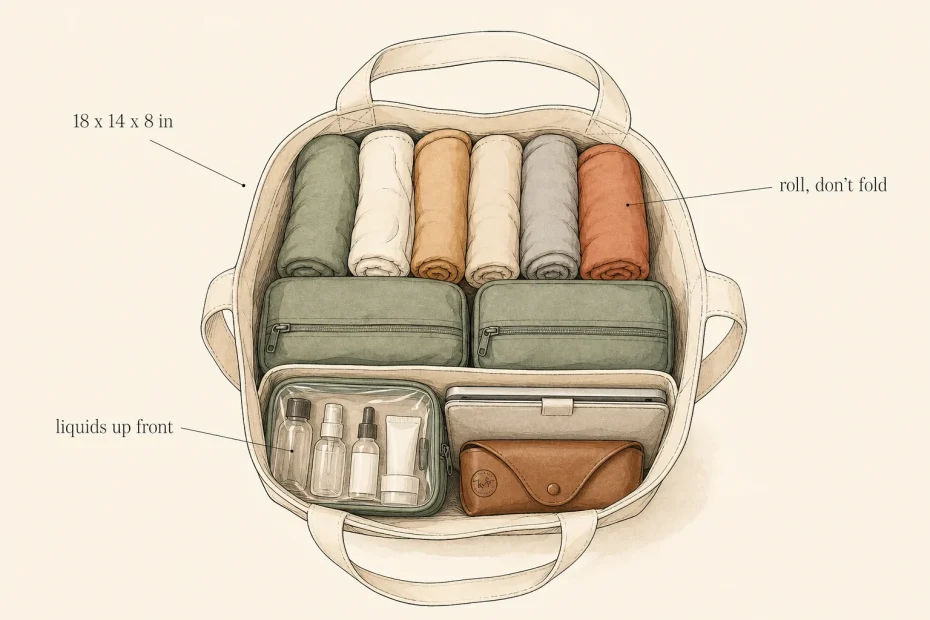
Here is the travel secret airlines never advertise: the bag that slides under the seat in front of you is free on every flight — and a thoughtfully packed tote bag can carry a four-day trip, a laptop, and a packed lunch without a single baggage fee. The catch is that most people stuff a tote until it bulges, and that bulge is exactly what gets it measured, gate-checked, and billed. This guide walks you through the exact packing order, the airline size limits that actually matter in 2026, and the gear that turns an ordinary tote into the most efficient bag you own.
How to Pack a Tote Bag as a Personal Item: The Underseat Method That Fits Every Airline
What counts as a personal item — and why a tote is the smartest choice
A personal item is any bag that fits completely under the seat in front of you, and every major U.S. airline includes one free with your fare. United, for example, defines its personal item limit as 9 × 10 × 17 in (22 × 25 × 43 cm), and lists “purses, backpacks and laptop bags” as the typical items passengers use it for United’s carry-on policy. A carry-on is different: it lives in the overhead bin, is limited to roughly 22 × 14 × 9 in (56 × 35 × 23 cm) on most U.S. airlines, and on budget carriers it can cost $60–100 extra (SmarterTravel’s 2026 carry-on rules).
The tote is the personal item of choice for one simple reason: access. In a terminal or on a plane, you can reach into an open tote without taking it off your shoulder or unzipping a panel — wallet, passport, phone, and headphones stay within arm’s reach the whole trip. Compare that with a backpack, which wins on comfort but loses every time you need something at the bottom.
Here is the number that changes how you pack: a tote sized 18 × 14 × 8 in (46 × 36 × 20 cm) holds about 33 liters — the same volume as a serious hiking backpack. That is enough for three to five days of clothing when packed in layers, plus a laptop, toiletries, and a jacket layer. The math is simple: 18 × 14 × 8 = 2,016 cubic inches (33 liters), and the only dimension you need to respect is the one airlines measure.
The Short Answer
A personal item is a bag that fits fully under the seat in front of you and is free on every major airline. The safest universal size is 18 × 14 × 8 in (46 × 36 × 20 cm). Packed in layers — heavy items low, rolled clothes in cubes, liquids at the top — a tote comfortably holds three to five days of clothing plus tech.
Personal item size limits in 2026: the airline cheat sheet.
The single most useful fact in modern air travel is this: if your packed tote fits inside 18 × 14 × 8 in (46 × 36 × 20 cm), it clears every major U.S. airline’s personal item rule. That size is the published limit for Frontier and Spirit, and it is comfortably inside the “fits under the seat” requirement used by American, Delta, JetBlue, Alaska, and Southwest, according to Forbes’ personal item bag guide. The one exception to watch is United, whose official personal item box is a narrower 9 × 10 × 17 in (22 × 25 × 43 cm) — the 10-inch depth is the dimension that catches bulky totes.
| Airline | Personal item limit | What you need to know |
|---|---|---|
| United | 9 × 10 × 17 in (22 × 25 × 43 cm) | Published limit; watch the 10 in (25 cm) depth |
| American, Delta, JetBlue, Alaska | Must fit under the seat (18 × 14 × 8 in is the safe zone) | No published personal item box; a 16 in tote never gets a second look |
| Frontier | 18 × 14 × 8 in (46 × 36 × 20 cm) | Free; a separate carry-on costs $60–100 |
| Spirit | 18 × 14 × 8 in (46 × 36 × 20 cm) | Free; carry-on fees run $65–100 |
| Southwest | Must fit under the seat (no published limit) | Lowest pressure: two bags fly free |
| Ryanair | 40 × 20 × 25 cm (15.7 × 7.9 × 9.8 in) | All fares include one small under-seat bag. Ryanair’s bag rules |
| easyJet | 45 × 36 × 20 cm (17.7 × 14.2 × 7.9 in) | One small under-seat cabin bag free easyJet’s cabin bag policy |
Enforcement is the real story of 2026. Airlines are measuring bags at the gate with automated scanners instead of relying on the honor system; the old grace period for soft-sided bags is gone; and gate-check fees run $35–65 on major carriers and $75–100 on budget carriers. SmarterTravel’s 2026 carry-on rules. A machine does not negotiate, so the cheap insurance is measuring your tote at home, packed, before you fly.
Tote as a personal item: the underseat method
Personal item discussions have a packing method at the center: the tote fits the underseat space and carries the essentials. The conversations are consistent — the tote is the smartest personal item for the flights, and the underseat method — the soft-sided dimensions, the compression packing, and the essentials-first order — makes the tote work.
The practical advice: check the airline’s personal item dimensions and choose the soft-sided tote that flexes into the sizer, and pack the compression cubes and the essentials in the reachable order — the documents, the chargers, and the comfort items on top. The tote that works as the personal item is the one packed to the limits and organized for the access. The underseat method is the packing discipline, not the bag size.
The Cheat Sheet
Personal item limits vary: United allows 9 × 10 × 17 in (22 × 25 × 43 cm), Frontier and Spirit allow 18 × 14 × 8 in (46 × 36 × 20 cm) and charge $60–100 for any carry-on, Ryanair caps its free bag at 40 × 20 × 25 cm, and easyJet at 45 × 36 × 20 cm. Pack to 18 × 14 × 8 in, and you clear every U.S. airline.
The 7-layer tote packing method
Most people pack a tote the way they pack a grocery bag — things land wherever they fall, and the top of the bag mushrooms into a dome. That dome is the failure point: an overstuffed top is the fastest way to fail a sizer. The fix is a fixed packing order that mirrors how weight behaves: heavy and dense at the bottom, soft and light at the top, with a flat, level surface across the opening. Here is the method, layer by layer.
- Layer 1 — the floor: heaviest items flat. Shoes (packed heel-to-toe in a shower cap or dust bag), a toiletry bag for non-liquid gear, and any hard items go flat on the bottom panel. Keeping mass low does two things: the bag sits upright instead of slouching, and it stops your shoulder from carrying a pendulum. A bag that keeps its shape is a bag that passes a sizer.
- Layer 2 — the rolling wall: casual clothes upright. Roll T-shirts, leggings, and knitwear into tight cylinders and stand them upright like files in a drawer. Upright rolls fill the full height of the tote, are visible at a glance, and let you pull one garment without collapsing the rest — the same reason packing-cube devotees roll Wirecutter’s roll-versus-fold test.
- Layer 3 — compression cubes: the space doubler. Group the rolls into one or two compression packing cubes. The compression zipper squeezes trapped air out of fluffy fabrics, which is where the real space gain lives: air, not fabric, is what fills a bag. A 6-piece cube set covers a week-long trip and keeps the tote structured.
- Layer 4 — the flat spine: laptop and tablet. Slide the laptop into a padded sleeve and stand it flat against the back panel of the tote. A 16-inch-wide tote holds a 15-inch laptop with room to spare; even a 13-inch model leaves a channel beside it for a book or a flat pouch.
- Layer 5 — liquids, up top and up front. The TSA 3-1-1 rule allows liquids, aerosols, gels, creams, and pastes only in containers of 3.4 oz (100 ml) or less, all inside one clear quart-sized zip-top bag. TSA’s liquids rule. Put that bag in a front pocket or on top of the tote where you can grab it in one motion at security. Powders, incidentally, can travel in larger amounts: up to 12 oz (350 ml) on domestic U.S. flights, per United’s carry-on guidance.
- Layer 6 — the leveling layer: flat, soft items on top. Folded button-downs, dresses, and the sweater you plan to wear land here, folded flat to cap the pile. Folding, not rolling, keeps structured fabrics crisp — the fold-versus-roll trade-off in one sentence: rolling saves space and shows options, folding saves wrinkles and builds a flat surface, Wirecutter’s packing tests.
- Layer 7 — the access pocket: what you touch on the flight. Passport, phone, charger, earbuds, pen, lip balm, and medication go in the final pocket, plus anything you cannot lose if the bag is gate-checked. Airlines explicitly advise keeping medication, keys, and essentials in your personal item because it is the bag that stays with you if your carry-on gets checked at the gate —United’s packing guidance.
Three rules make or break the method. First, never leave the tote zipped overstuffed — the top should be level, not domed. Second, never fly with an expansion zipper open; expanded bags are the first thing gate agents flag. SmarterTravel’s 2026 carry-on rules. Third, wear your heaviest layers through security — jackets and coats do not count against your allowance, so a puffer worn through the terminal is a free checked layer.
The 30-Second Version
Pack your tote in seven layers: heavy items flat on the floor, upright rolled clothes, compression cubes, a flat laptop spine against the back panel, a TSA-ready liquids pouch up top, a leveling layer of folded items, and an access pocket for passport and medication. Never overstuff the top, never expand zippers, and wear your heaviest layers through security.
Related Topics You May Find Helpful
Will my tote pass the sizer? Measure the way airlines do
Airlines measure total exterior dimensions — full height from the bottom to the highest handle point, full width including every protruding pocket, and full depth from front to back. Internal capacity is irrelevant to SmarterTravel’s 2026 carry-on rules. So measure your tote packed, not empty: a bag with an 18-inch spec can measure 19 inches once a padded laptop sleeve and a water bottle bulge the sides. Do the three-check routine before every flight: measure packed, test that the handles lay flat, and zip an overstuffed tote down to a level top. If it does not fit your airline’s published box at home, it will not fit at the gate.
Tote vs. backpack: which wins under the seat?
Both fit under the seat; the difference is how you trade access against comfort. A tote gives instant access from your shoulder — wallet, passport, and headphones in seconds — and reads as more polished in work settings. A backpack distributes weight across both shoulders, which matters on a 20-minute terminal walk or a connection with a 15 lb (7 kg) bag. The honest verdict for 2026 travel: choose the tote for short-haul flights, business trips, and any trip where you will open the bag often; choose a backpack for long airport walks, heavy camera or toddler gear, and budget-airline marathons where the bag is your only luggage. Frequent fliers often keep both — a tote that fits inside a backpack for the return leg with souvenirs.
| Factor | Tote | Backpack |
|---|---|---|
| Access speed | Fast — open from the shoulder | Slow — must unshoulder and unzip |
| Weight distribution | One shoulder; heavy loads tire faster | Both shoulders; better for 10+ lb (4.5+ kg) loads |
| Security in crowds | Open top is an easier target | Zippered panels against the body |
| Packing structure | One big compartment; needs cubes or pouches | Built-in compartments and organizers |
| Style signal | Works from terminal to meeting | Casual and outdoorsy |
Roll or fold? The physics of fitting more
Neither rolling nor folding is a universal space winner — but each has a clear job, and the fastest packs combine them. In Wirecutter’s controlled tests, folded clothes came out with fewer wrinkles after 24 hours packed, while rolled clothes let you see every option at a glance and fill awkward crevices around the bag’s edges —Wirecutter’s roll-versus-fold guide. The space champion is a military technique called the ranger roll: fold the shirt vertically in thirds, create a cuff at the hem, roll toward the collar, then tuck the roll into the cuff. The tucked cuff locks the roll tight, and a bag full of locked cylinders has almost no air gaps. The professional shorthand: roll casual, fold formal — leggings and T-shirts roll, button-downs and dresses fold.
What should never go in your personal item?
Three categories deserve your attention before you zip up. Liquids over 3.4 oz (100 ml) must go in checked baggage — a full-size sunscreen or shampoo bottle in a tote means a security-bin delay or confiscation, no exceptions. TSA’s liquids rule. Powders over 12 oz (350 ml) are allowed domestically but subject to extra screening, so they belong in checked bags when possible. And if you carry a “smart bag” with a lithium battery, the battery must be removed before boarding — the bag itself cannot fly with it installed under United’s smart bag rule. On the flip side, the one thing that must always stay in your tote is anything you cannot replace: medication, keys, documents, and chargers live in the personal item precisely because it is the bag that never leaves you.
Why canvas is the sustainable personal-item choice
If you are going to carry one bag for years of flights, the material matters as much as the size. Heavy-duty cotton canvas totes are washable, durable, and biodegradable at end of life, and organic cotton is widely considered the most sustainable tote material overall — conventional cotton and canvas both beat single-use alternatives on reuse alone. Good On You’s sustainable tote guide. A structured canvas tote also does double duty: it is the personal item on a flight, the farmers-market bag at the destination, and the beach bag on the way home. That is the whole philosophy behind the bags we make in Montana — one well-made, natural-fiber bag that replaces a drawer of disposable ones. One honest note: for underseat flights, choose a canvas tote no wider than 18 in (46 cm); the roomy 22 in (56 cm) canvas classics belong on road trips, trains, and as carry-ons on airlines with generous limits.
Bottom Line
Measure your tote packed, including handles and pockets — soft-sided grace periods are gone and automated sizers do not negotiate. Choose a tote when you value fast access and style, a backpack for long walks and heavy loads. Roll casual clothes, fold formal ones, keep liquids under 3.4 oz (100 ml) in a quart bag, and never fly with an expanded zipper.
What we covered
- A personal item is free on every major airline; the universal safe size is 18 × 14 × 8 in (46 × 36 × 20 cm), except United’s tighter 9 × 10 × 17 in (22 × 25 × 43 cm).
- An 18 × 14 × 8 in tote holds roughly 33 liters — enough for three to five days of clothing plus tech when packed in layers.
- Pack in seven layers: heavy items low, upright rolled clothes, compression cubes, laptop spine, liquids up top, leveling folds, access pocket last.
- TSA allows liquids only in 3.4 oz (100 ml) containers inside one clear quart bag; powders up to 12 oz (350 ml) domestically.
- Roll casual clothes and fold formal ones; the military ranger roll saves the most space; compression cubes remove air, not fabric.
- Measure the bag packed — airlines measure exterior dimensions including handles and pockets, and automated gate scanners do not negotiate.
- Never fly with an expansion zipper open, never overstuff the top into a dome, and wear your heaviest layers through security.
FAQ: packing a tote for a flight
Can I use a tote bag as my personal item on a plane?
Yes. Airlines routinely name purses, laptop bags, and similar soft bags as acceptable personal items; a tote that fits completely under the seat in front of you qualifies. The only test that matters is the fit.
What size tote bag fits under an airplane seat?
On U.S. airlines, a tote up to 18 × 14 × 8 in (46 × 36 × 20 cm) fits the vast majority of underseat spaces; United’s published limit is 9 × 10 × 17 in (22 × 25 × 43 cm). A 16-inch-wide tote is the safest universal choice. On Ryanair, the free bag must fit 40 × 20 × 25 cm; on easyJet, 45 × 36 × 20 cm.
How many days of clothes fit in a personal-item tote?
With upright rolling and compression cubes, most travelers fit three to five days of clothing, a laptop, toiletries, and a pair of shoes in a 30–35 liter tote. Plan outfits before you pack, and wear your bulkiest items on the plane.
Does a tote count as a carry-on or a personal item?
It depends on where it goes. Under the seat in front of you, it is a personal item — free on every airline. In the overhead bin, it is a carry-on, which is free on most full-service airlines but costs $60–100 on Frontier, Spirit, and Allegiant. SmarterTravel’s 2026 carry-on rules.
Can I bring a purse plus a tote as personal items?
No — the allowance is one personal item per passenger. United states it plainly: small purses or bags are not allowed in addition to your personal item and carry-on —United’s carry-on policy. Choose one bag, or tuck the smaller one inside it.
Are tote bags allowed on Frontier and Spirit?
Yes, if they fit the 18 × 14 × 8 in (46 × 36 × 20 cm) box. On these airlines, the personal item is your only free bag, so a well-packed tote is the difference between a $0 flight and a $60–100 surcharge.
What happens if my tote does not fit under the seat?
It gets gate-checked, which costs $35–65 on major airlines and $75–100 on budget carriers, and you lose access to its contents for the flight. SmarterTravel’s 2026 carry-on rules. Keep medication, keys, and documents in a pocket you can pull out if this happens.
What liquids can I pack in my personal item?
Travel-sized containers of 3.4 oz (100 ml) or less, all placed inside one clear quart-sized zip-top bag — the TSA 3-1-1 rule (TSA’s liquids rule). Anything larger goes in checked baggage.
The gear that makes the tote method work
Here is the honest part nobody puts in a packing list: no bag can fix a bad packing order. We tested this method across five very different totes — from a purpose-built underseat bag to a $25 canvas classic — and in every case the layer order mattered more than the price tag. What the right gear does is remove friction: a structured base holds the shape that passes sizers, compression cubes do the squeezing for you, and a TSA-ready liquids pouch ends the quart-bag guessing game. These five picks are the ones that earned a permanent spot in the rotation. Prices reflect what we found on Amazon in July 2026.
| Pick | Why it earns a spot |
|---|---|
| Underseat carry-on travel tote (16 in) | Purpose-built for the 18 × 14 × 8 in box; structured base, shoe compartment, and a width that clears Frontier and Spirit sizers around $40. |
| BAGSMART expandable quilted tote | Structured puffer tote that moves from office to airport; expands for the return leg with souvenirs (zip it closed before the sizer). |
| BAGSMART compression packing cubes | The Layer 3 workhorse — compression zippers squeeze air out of knits and turn a jumble into a tidy brick that keeps the tote’s shape. |
| TSA-approved clear quart toiletry bags, 2-pack | Pre-sized to the 3-1-1 rule so the liquids pouch is always compliant; one for liquids, one for cables, around $13. |
| Sage green extra-large canvas tote (22 in) | The sustainable classic: heavy cotton canvas, zipper top, washable and biodegradable. For road trips, trains, and everyday carry — on underseat flights, choose a tote no wider than 18 in. |
- The underseat specialist. A 16-inch-wide travel tote with a structured base and shoe compartment is the closest thing to a cheat code for budget airlines — it clears Frontier’s and Spirit’s 18 × 14 × 8 in boxes without a second look. See the underseat tote built for Frontier and Spirit.
- The work-and-travel tote. A quilted, expandable tote carries a laptop and meeting clothes to the airport and expands for the way home. Just remember the golden rule: zip the expansion closed before boarding. Check the expandable tote that moves from office to airport.
- The space doubler. Compression cubes are where the 33-liter promise actually comes true — they remove the air, not the clothes, and keep your tote stiff enough to hold its shape in a sizer. Grab the compression cubes that double your space.
- The security shortcut. A clear quart-size toiletry bag ends the most avoidable airport delay: the 3-1-1 re-packing shuffle at the security bin. Get the TSA-ready quart bags for stress-free security.
- The sustainable classic. For road trips, trains, and everyday carry, a 22-inch cotton canvas tote with a zipper top is the bag you will still own in a decade — washable, repairable, and biodegradable at the end of its long life. Shop the sage canvas tote for the slow-travel set.
The Bottom Line
No single bag makes the method work — order and restraint do. That said, a purpose-built 16-inch underseat tote, a set of compression cubes, and a TSA-ready quart bag remove the guesswork entirely. Whatever you carry, verify your packed tote against your airline’s published dimensions before you leave home, and the gate will never be a surprise.
Sources
- TSA — Liquids, Aerosols, and Gels Rule
- TSA — Travel Checklist (3-1-1 rule)
- United Airlines — Carry-on bags and personal item limits
- Delta Air Lines — Carry-on baggage
- SmarterTravel — Carry-On Luggage Rules 2026: Size Limits for Every Major Airline
- Forbes — Best Personal Item Bags 2026
- Wirecutter (NYT) — Should You Roll or Fold Your Clothes When You Pack?
- Ryanair — Bag Rules
- easyJet — Cabin bags
- Good On You — Climate-Friendly Sustainable Tote Bags