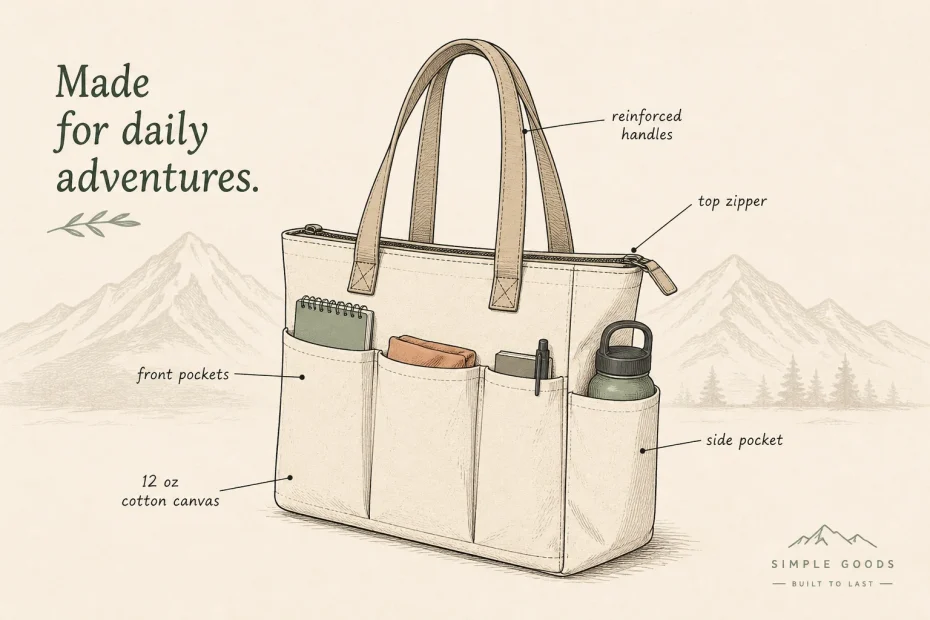
The most “eco-friendly” bag you can own is also the easiest one to waste. A cotton canvas tote has to be carried roughly 7,100 times before it matches the environmental footprint of a single-use plastic bag — and most free promotional totes never get anywhere close. The fix is not a fancier fabric; it is a bag you actually want to carry every single day. That means a smooth zipper that keeps your wallet, keys, and phone from vanishing mid-commute, pockets that end the “where did I put it” shuffle, and a sturdy 12-ounce (407 g/m²) canvas body that can shrug off a full farmers-market haul for a decade. Whether you are shopping for your first one or replacing a bag that gave up in August, this guide covers what canvas really is, why the zipper and pockets matter more than the label, how to pick a bag that lasts, and how to care for it so the math finally works in your favor.
The Canvas Tote Bag with Zipper and Pockets: The Best Guide to Choosing, Using, and Caring for the Everyday Bag That Does It All
What Is a Canvas Tote Bag with Zipper and Pockets?
A canvas tote bag with a zipper and pockets is a flat-bottomed, open-handled carryall made from woven cotton canvas, fitted with a zippered top closure and at least one interior or exterior pocket. The word “tote” has been English slang for “to carry” since the 1600s, and the modern canvas tote was popularized in 1944, when L.L. Bean introduced its “Boat and Tote” (originally called Bean’s Ice Carrier) in Maine — a bag still made in the United States today. The zippered, pocketed version is a 21st-century refinement: it takes the classic open tote. It adds the two features that make it safe for daily urban life — a closure that keeps contents in (and hands out), and organized storage that makes the bag genuinely useful as an everyday carry piece rather than a shopping sack.
In practical terms, these bags span a wide range: small 11 by 13 inch (28 by 33 cm) organizers for daily essentials, midsize 14 by 16 inch (36 by 41 cm) totes that fit a 13-inch (33 cm) laptop, and extra-large 22-inch (56 cm) grocery and market haulers. What unifies them is the material — heavy woven cotton — and the closure system.
The Short Answer
A canvas tote with a zipper and pockets is a durable cotton carryall with a secure top closure and organized storage. It bridges the gap between a disposable shopping bag and a structured handbag: the canvas brings strength and washability, the zipper brings security, and the pockets bring daily usability. This combination is why the canvas segment now holds 30.3 percent of the global tote bag market.
Why Canvas? The Fabric Science Behind the World’s Oldest Workhorse
Canvas is a tightly woven, plain-weave fabric traditionally made from hemp or flax — the English word comes from the Latin “cannabis,” literally “made of hemp,” and has been in use since the mid-14th century. Today most bag canvas is cotton, and its defining trait is a dense, balanced weave that gives it strength far beyond its weight.
Here is the entertaining science: canvas strength comes from the weave, not the fiber thickness. In a plain weave, every warp thread (running the length of the fabric) crosses over and under every weft thread (running across it), locking each thread in place. This interlocking grid distributes stress across many threads at once — which is why a canvas bag can carry heavy groceries while a knit or felt bag of the same weight tears at the seams. Cotton fibers themselves are hollow and hygroscopic: textile standards put cotton’s standard moisture regain at 8.5 percent, meaning the fibers absorb and release moisture from the air. That is why canvas breathes in summer heat, softens and molds to your shoulder over years of use, and dries out instead of trapping sweat against your body like synthetic fabrics.
Canvas is graded by weight in ounces per square yard, and the number matters more than any label. A #12 duck canvas weighs 11.5 oz/sq yd, while a #1 canvas weighs about 27 oz/sq yd; bag makers most often use 10 to 12 oz (339 to 407 g/m²) canvas for everyday totes and heavier 14 to 16 oz (475 to 542 g/m²) duck for workhorse bags.
Canvas Weight Guide
| Canvas weight | Metric equivalent | Typical use | Best for |
|---|---|---|---|
| 7–8 oz (light) | 237–271 g/m² | Promotional totes, reusable shopping bags | Folding flat, light loads |
| 10–12 oz (standard) | 339–407 g/m² | Everyday totes, market bags, work totes | Daily carry, laptops, groceries |
| 14–16 oz (heavy duck) | 475–542 g/m² | Workhorse totes, travel bags, tool bags | Heavy loads, years of abuse |
| 18 oz and up (extra heavy) | 610+ g/m² | Industrial, upholstery-grade canvas | Extreme durability, structured bags |
The practical rule: if a bag does not state its fabric weight, assume the cheapest lightweight canvas. A genuine 12 oz (407 g/m²) tote stands up on its own, holds its shape when loaded, and survives hundreds of washings; a 7 oz (237 g/m²) tote folds like a T-shirt and wears through at the corners within a year or two.
The canvas tote’s hidden cost
The canvas tote is the most visible symbol of the reusable-bag movement, and the sustainability discussions around it have become more honest. The frequently cited figure — a cotton tote must be used thousands of times to offset its production footprint — surprises people, but the community consensus is not to abandon totes; it is to use them relentlessly.
The practical advice: buy a tote you will actually keep with you, choose heavyweight canvas for durability, and prefer designs with a zipper or closure for everyday carry. A tote that becomes your default bag for years is genuinely sustainable; one that collects dust in a closet is not, whatever its label says.
The Fabric Science in Brief
Canvas gets its toughness from a dense plain weave that spreads stress across interlocked threads, and from cotton’s 8.5 percent moisture regain, which makes it breathable, absorbent, and progressively softer with use. Fabric weight, measured in ounces per square yard (about 33.9 g/m² per ounce), is the single best predictor of durability: 10 to 12 oz (339 to 407 g/m²) suits everyday bags, while 14 to 16 oz (475 to 542 g/m²) suits heavy-duty use.
Why the Zipper Matters More Than You Think
A zipper is the single feature that turns a carryall into a secure bag — and it is the feature most cheap totes skip. On a bus, a crowded market, or a school hallway, an open tote is an invitation: the top of the bag is at waist height behind you, exactly where pickpockets and accidental spills operate. A zippered tote closes that opening completely, protects contents from rain and dust, and keeps pens, lip balm, and loose change from scattering across a parking lot when the bag tips over.
The zipper itself is a surprisingly modern invention. Swedish-American engineer Gideon Sundback patented the “Hookless Fastener No. 1” on April 29, 1913, and followed with the improved “Separate Fastener” patent in 1917 — the design of interlocking teeth and a sliding mechanism that every modern zipper still uses. It took decades for zippers to move from boots and tobacco pouches into clothing and bags; today, a quality zipper on a tote is engineered for tens of thousands of open-close cycles.
When you inspect a tote’s zipper, check three things: the teeth (metal teeth are strongest and most durable, coil zippers are smoother and quieter), the slider (it should glide without catching and lock when released), and the tape attachment (the zipper must be stitched into a reinforced seam, not just tacked on). A failing zipper is the most common reason a good tote dies early — so this one component is worth paying extra for.
Why Zippers Earn Their Keep
A top zipper converts an open carryall into a secure, weather-resistant bag, protecting valuables from theft, spills, and rain. The modern zipper has existed since Sundback’s 1913 patent, and its reliability has only improved since. When choosing a tote, inspect the teeth, slider, and stitching: metal teeth for maximum strength, coil for smoothness, and always a reinforced zipper seam.
Pockets and Compartments: The Organization Payoff
Pockets are what make a tote a system instead of a sack. The most useful layouts pair a zippered interior pocket for valuables (phone, wallet, keys) with open slip pockets for items you grab constantly (sunglasses, hand sanitizer, transit card) and one or two exterior pockets for a water bottle, umbrella, or notebook. The goal is simple: everything has a fixed home, so nothing rolls around the bottom of the bag and nothing requires a two-minute dig at the checkout counter.
Match the pocket layout to the job:
- Grocery and market runs: one large open main compartment, plus two deep exterior pockets for bottle storage — items that would crush a loaf of bread stay in the side pockets.
- Work and commuting: a padded or dedicated laptop sleeve (13 to 16 in / 33 to 41 cm), one zippered interior valuables pocket, and two to three slip pockets for chargers, pens, and a badge.
- Travel and carry-on: a zippered main compartment, a passthrough back pocket that slides over a suitcase handle, and an exterior pocket for a passport or boarding pass.
- School: three compartments (laptop, books, supplies) with a zippered top so nothing escapes on the bus.
- Everyday carry: a small 11 by 13 inch (28 by 33 cm) tote with one zippered pocket and two slip pockets — just enough structure for a phone, wallet, keys, and a book.
The Pocket Principle
The best pocket layout matches the bag to its job: zippered interior pockets protect valuables, open slip pockets serve grab-and-go items, and exterior bottle pockets keep heavy or crushable items separated. A well-organized tote eliminates the daily “where is it” search and gets carried more often — and a frequently carried bag is exactly what makes canvas an environmentally sound choice.
The Honest Environmental Math
Here is the uncomfortable truth most tote marketing skips: a cotton canvas bag is worse for the environment than a plastic bag unless you reuse it many, many times. According to the Danish Environmental Protection Agency’s 2018 Lifecycle assessment, a conventional cotton tote must be used about 7,100 times to offset its production impact, and an organic cotton tote about 20,000 times — because organic cotton yields about 30 percent less fiber and therefore needs about 30 percent more land and water. Columbia University’s Climate School, which summarizes this research, is blunt about it: of all the bag types studied, cotton totes carry the heaviest production footprint.
Do the arithmetic honestly. At once-a-day use, 7,100 reuses takes about 19.5 years; at twice a week, about 68 years. That is why the free tote sitting in your closet is an environmental loss, not a win — it was produced, shipped, and will be discarded without ever paying back its footprint. The only canvas tote that makes environmental sense is one you genuinely carry constantly, for years.
The context matters too. Americans use an estimated 100 billion plastic shopping bags per year, and the U.S. Environmental Protection Agency found that less than five percent are recycled. Plastic bags take an estimated 20 to 1,000 years to break down, fragmenting into microplastics under 5 millimeters that have been found in marine animals worldwide. And the regulatory ground is shifting: eight states — California, Connecticut, Delaware, Hawaii, Maine, New York, Oregon, and Vermont — have statewide single-use plastic bag bans, according to the National Conference of State Legislatures. California’s SB 1053 law phases out all plastic shopping bags entirely starting January 1, 2026, and Washington State added a 12-cent charge on thick-film reusable bags the same day.
| Bag type | Fossil fuel use (per 1,000 paper-bag-equivalent capacity) | Fresh water | CO2-equivalent emissions | Reuses needed to match LDPE plastic |
|---|---|---|---|---|
| HDPE plastic (typical checkout bag) | 14.9 kg | 58 gal (220 L) | 0.04 tons | — (baseline) |
| Paper bag | 23.2 kg | 1,004 gal (3,800 L) | 0.08 tons | 1–43 (unbleached to bleached) |
| Conventional cotton tote | Highest of all studied | Very high | Highest of all studied | About 7,100 |
| Organic cotton tote | Highest of all studied | About 30% more than conventional | Highest of all studied | About 20,000 |
This is not an argument against canvas — it is an argument for buying one good bag and using it relentlessly. The zipper and pockets are the sustainability features: they are what make a tote suitable for daily commuting, travel, and school, which is how a bag reaches hundreds of uses per year instead of twelve. And because canvas is washable, it stays hygienic: a study of reusable shopping bags found bacteria in nearly all bags tested, with E. coli in 12 percent — but washing bags in warm or hot water reduced bacteria by 99.9 percent.
The Environmental Bottom Line
A cotton tote offsets its footprint only after about 7,100 uses (conventional cotton) or 20,000 uses (organic) — at daily carry, that is roughly 19.5 to 55 years. The sustainable choice is therefore one high-quality canvas bag you use constantly, not a collection of promotional totes. Washable canvas plus a zippered, pocketed design make daily use practical, which is the only way the environmental math works.
How to Choose a Canvas Tote That Lasts: A 7-Point Checklist
Buying a tote by looks alone is how people end up with a sagging, broken-bag drawer. Work through these seven checks instead:
- Fabric weight. Look for 12 to 16 oz (407 to 542 g/m²) cotton canvas. If the listing does not state a weight, move on — it is almost certainly lightweight promo-grade cloth.
- Zipper quality. Metal teeth for maximum durability, coil for smoothness; the slider should lock, and the zipper must be stitched into a reinforced seam.
- Pocket layout. At minimum, one zippered interior pocket and one open slip pocket. Match the rest to your use (laptop sleeve for work, bottle pockets for markets).
- Stitching. Double-stitched seams and bartack reinforcements (dense zigzag stitches) at every stress point, especially where handles meet the body.
- Handles. Reinforced webbing or doubled canvas, with a comfortable drop of about 10 to 12 inches (25 to 30 cm) so the bag sits at hip height.
- Size. Measure what you will carry: a 13-inch (33 cm) laptop needs a 14 by 16 inch (36 by 41 cm) bag; a full grocery run needs an 18 to 22 inch (46 to 56 cm) bag or two midsize ones.
- Washability. Pre-washed, machine-washable canvas saves heartbreak later — unwashed canvas can shrink noticeably on its first wash.
Size Guide for Zippered Canvas Totes
| Size | Approximate dimensions | Capacity feel | Best for |
|---|---|---|---|
| Small | 11 × 13 in (28 × 33 cm) | Daily essentials only | Errands, lunch, everyday carry |
| Medium | 14 × 16 in (36 × 41 cm) | Fits a 13-in (33 cm) laptop | Work, school, commuting |
| Large | 16 × 18 in (41 × 46 cm) | Fits a 15–16-in (38–41 cm) laptop plus layers | Travel, carry-on, weekend trips |
| Extra large | 20–22 in (51–56 cm) wide | Full grocery haul | Farmers markets, laundry, bulk shopping |
The Choosing Checklist
Seven checks separate a ten-year bag from a one-season bag: a stated fabric weight of 12 to 16 oz (407 to 542 g/m²), a quality zipper with reinforced seam, a pocket layout matched to your routine, double-stitched seams with bartacks, reinforced handles with a 10 to 12 inch (25 to 30 cm) drop, the right dimensions for your laptop or grocery load, and pre-washed machine-washable fabric. Size the bag to your heaviest recurring use.
Related Topics You May Find Helpful
Is a canvas tote actually better for the environment than plastic?
Only if you use it enough, Lifecycle assessments show a conventional cotton tote must be reused about 7,100 times to match the environmental profile of a single-use plastic bag, and an organic cotton tote about 20,000 times. Used daily, that is roughly 19.5 to 55 years of service. The practical answer: one well-made canvas tote carried constantly beats both plastic bags and a collection of rarely used free totes. Buying a bag you will genuinely use daily — which is what a zipper and pockets enable — is the single most important sustainability decision in this category.
Canvas totes are not automatically better simply because they are made from cotton. Their environmental value comes from repeated use. A plastic checkout bag may have a lower production footprint, but it is usually used once, rarely recycled, and can persist for decades or centuries as litter and microplastic pollution. A well-made canvas tote becomes the better choice when it replaces hundreds or thousands of disposable bags over time, especially because it is washable, repairable, and useful enough to carry every day. That is why the goal is not to collect more reusable bags, but to stop depending on single-use plastic bags and choose one durable tote that actually stays in rotation.
What does “12 oz canvas” mean, and is heavier always better?
Canvas weight is measured in ounces per square yard (1 oz/sq yd = about 33.9 g/m²). A 12 oz canvas therefore weighs about 407 g/m², and a 16 oz canvas about 542 g/m². Heavier canvas is tougher and holds its shape longer, but it is also stiffer and heavier to carry empty — a 16 oz tote weighs noticeably more on your shoulder. For most people, 12 to 14 oz (407 to 475 g/m²) is the sweet spot: durable enough for daily use and groceries, light enough to carry comfortably. Reserve 16 oz and up for tool bags, travel, and other abuse-heavy jobs.
Canvas vs leather vs nylon totes: which lasts longest?
For the price, canvas is the durability champion. Nylon totes are lightweight and water-resistant but degrade in sunlight and develop a permanent odor; leather totes age beautifully but cost five to twenty times more and require conditioning. A 12 to 16 oz cotton canvas tote is washable and breathable. It typically lasts 5 to 10 years of daily use — and when it finally wears out, cotton is biodegradable, unlike nylon, which is petroleum-based. The honest trade-off: canvas is not waterproof (waxed canvas is the rain-ready upgrade), and it is heavier than nylon.
Is a zippered tote more secure than an open one?
Yes, in every practical sense. An open tote leaves its contents visible and reachable, and because the bag hangs behind the carrier’s hip, it is a target for pickpockets in crowds and transit. A zippered tote closes the opening entirely, keeps contents inside during drops and spills, and protects against rain and dust. Interior zippered pockets add a second layer of protection for wallets and phones. For commuting, travel, and anything involving crowds, a zipper is the difference between a carryall and a liability.
Are tote bags still trending in 2026?
Tote bags are not just trending — they are the fastest-growing major bag category. Research firms put the global tote bag market at about $2.5 to $3.1 billion in 2026, growing at 5.2 to 5.3 percent annually toward $3.78 to $4.4 billion by the early 2030s. Canvas is the leading material, holding 30.3 percent of the market in 2025, and the canvas bags segment is projected to grow from $1.1 billion in 2025 to $1.17 billion in 2026 alone. Plastic bag bans, remote-work commuting patterns, and the shift toward fewer, better bags drive the growth.
Five Verified Canvas Totes with Zippers and Pockets That Do the Job
Rather than point you at vague “leading picks,” here are five live, in-stock canvas totes with zippers and real pockets, checked on Amazon and chosen to cover every budget and use. Prices and ratings were current at the time of writing.
- TOPDesign Canvas Tote with External Pocket and Top Zipper — the value pick. A 100 percent 12 oz (407 g/m²) cotton canvas bag with a top zipper closure and an 8 by 8 inch (20 by 20 cm) external pocket, rated 4.6 stars from more than 6,800 reviews at about $12.74. Ideal first zippered tote for groceries, markets, and daily errands. Check today’s price on Amazon.
- Extra Large Canvas Tote with Zipper (22 inches, organic cotton) — the market hauler. A 22-inch (56 cm) zip-top tote made from 100 percent unbleached organic cotton, rated 4.5 stars at about $24.99. The generous width and sturdy handles handle a full grocery or farmers-market load, and the zip top keeps it civilized on public transit. See it on Amazon.
- KKXIU Large Canvas Tote with Zipper and Compartments — the workhorse. A structured 14.5 by 16.5 inch (37 by 42 cm) canvas tote with a zippered top, three compartments, and multiple pockets, rated 4.6 stars from nearly 2,000 reviews at about $19.99. The dedicated compartments keep a laptop, papers, and daily gear separated. View current price on Amazon.
- REDSINDA Canvas Tote with Zipper and Multiple Pockets — the budget organizer. A compact 14.5 by 11.8 inch (37 by 30 cm) tote with a zippered main compartment, an interior side pocket, and front and back pockets, rated 4.5 stars at about $12.99. Small enough for daily essentials, organized enough to replace a handbag. Check today’s price on Amazon.
- Canvas Tote with Multi-Pocket, Large Crossbody — the travel pick. A large multi-pocket canvas tote with zippered compartments and crossbody straps, rated 4.2 stars from about 1,300 reviews at about $24.89. The crossbody option keeps the bag anchored to your body in airports and crowds, and the compartment system swallows a travel day. See it on Amazon.
Comparison at a Glance
| Product | Key specs | Rating | Price (approx.) | Best for |
|---|---|---|---|---|
| TOPDesign Canvas Tote | 12 oz canvas, top zipper, external pocket | 4.6 / 5 (6,800+ reviews) | $12.74 | Value, groceries, errands |
| Extra Large Organic Cotton Tote | 22 in (56 cm), zip top, organic cotton | 4.5 / 5 (313 reviews) | $24.99 | Markets, bulk shopping |
| KKXIU Compartment Tote | Three compartments, zippered top, pockets | 4.6 / 5 (1,945 reviews) | $19.99 | Work, commuting, school |
| REDSINDA Pocket Tote | Zippered main, interior and exterior pockets | 4.5 / 5 (102 reviews) | $12.99 | Budget, everyday carry |
| Multi-Pocket Crossbody Tote | Zippered compartments, crossbody strap | 4.2 / 5 (1,298 reviews) | $24.89 | Travel, hands-free days |
How to Wash and Care for a Canvas Tote So It Lasts a Decade
Canvas is one of the easiest bag materials to maintain — that is its quiet superpower. Wash a zippered canvas tote in cold or warm water on a gentle cycle with mild detergent, then air-dry it flat or on a line. Skip the dryer: high heat shrinks cotton and can warp the zipper tape. Canvas that has not been pre-washed can shrink on the first wash, which is why pre-washed fabric is worth seeking out. If you want to minimize even that risk, handwashing in cool water with a soft brush.
- Stains: treat spots before washing with a paste of baking soda and water, or a dab of mild dish soap; scrub gently with a soft brush, rinse, and air-dry.
- Smells: grocery totes pick up bacteria from meat juices and produce — a study of reusable bags found E. coli in 12 percent of bags tested. Washing in warm or hot water eliminates 99.9 percent of bacteria; wash your market tote every few weeks.
- Mold and mildew: never store a damp canvas bag in a sealed space. Dry it fully, then brush off any mildew and treat with a diluted white vinegar solution.
- Zipper care: keep the teeth free of grit (it wears them down), and if the slider starts catching, run a wax pencil or candle along the teeth — never force it.
- Waterproofing: plain canvas is water-resistant at best. For serious rain protection, choose waxed canvas and re-wax it yearly with a fabric wax bar.
The Care Basics
Machine-wash a canvas tote in cold or warm water on gentle and always air-dry it — dryers shrink cotton and warp zippers. Treat stains before washing, wash market bags every few weeks to control bacteria (warm washing kills 99.9 percent), never store damp canvas, and lubricate a catching zipper with wax rather than forcing it. With this routine, a 12 to 16 oz canvas tote routinely lasts 5 to 10 years of daily use.
Spring Markets, Summer Trips, Fall Commutes: Using Your Tote Year-Round
The zippered canvas tote earns its keep across all three seasons that matter most for outdoor life. In late spring and summer, it is the farmers-market and beach bag: the organic cotton 22-inch (56 cm) style swallows produce and towels, the zip top keeps sand and spills contained, and canvas’s breathability means no sweaty handles in July heat. In early fall, the same bag becomes a commute and travel piece — the compartment style carries a laptop, a layer, and a water bottle through the airport without ever leaving your shoulder, and the zipper keeps boarding-pass essentials reachable and secure. As the school year starts, a zippered three-compartment tote is the increasingly popular campus alternative to the backpack, because it fits under a desk, stands up in a locker, and protects a laptop from both weather and crowded hallways.
The through-line is the same in every season: the bag that gets used daily is the one that is secure, organized, and easy to grab. That is the case for zippers and pockets — and the case for the environment, since daily use is the only way canvas pays back its production footprint. If you are weighing a zippered tote against a traditional open one, our work tote guide covers the commuting side of the argument, and our school-tote explainer digs into why students are switching from backpacks.
Frequently Asked Questions
Can I carry a laptop in a canvas tote?
Yes, if the bag is sized for it. A 14 by 16 inch (36 by 41 cm) tote fits most 13-inch (33 cm) laptops, and a 16 by 18 inch (41 by 46 cm) tote fits 15 to 16 inch (38 to 41 cm) models. Look for a padded or dedicated laptop compartment — a loose laptop in an unpadded canvas bag is vulnerable to corner impacts.
Do canvas totes shrink?
Unwashed cotton canvas can shrink noticeably on its first wash — often a few percent. Pre-washed canvas is shrunk during manufacturing and is safe to machine-wash. If in doubt, handwashing in cool water and air-dry for the first wash.
How much weight can a canvas tote hold?
It depends on construction more than fabric. A well-made 12 oz (407 g/m²) tote with double-stitched, bartacked handles comfortably carries a full grocery load — roughly 20 to 30 pounds (9 to 14 kg) — while a lightweight promo tote can fail at half that. Extra-large 22-inch (56 cm) market totes are built for the heaviest loads.
Are canvas totes waterproof?
No. Plain cotton canvas is water-resistant at best — it repels light rain briefly, then absorbs moisture. For genuine rain protection, choose waxed canvas (re-waxed yearly) or use a dry bag liner inside the tote for electronics.
How long does a canvas tote bag last?
With regular washing and air-drying, a 12 to 16 oz (407 to 542 g/m²) canvas tote typically lasts 5 to 10 years of daily use. The most common failure points are the zipper and the handle seams — which is why both deserve scrutiny at purchase time.
Why does my canvas tote smell after grocery shopping?
Bacteria grow on food residue left in the bag, especially meat juices. Studies of reusable bags found bacteria in nearly all samples. Wash the bag in warm or hot water every few weeks — that eliminates 99.9 percent of bacteria — and use a dedicated bag for meats.
What size canvas tote should I buy?
Measure your heaviest recurring load. Daily essentials only: 11 by 13 inches (28 by 33 cm). Laptop plus work gear: 14 by 16 inches (36 by 41 cm). Full grocery runs or travel: 18 to 22 inches (46 to 56 cm). When in doubt, size up — canvas totes collapse flat when empty.
Is a zippered tote better than a magnetic or snap closure?
For security, yes. Snap and magnetic closures deter casual rummaging but leave gaps; a full zipper seals the bag completely. Many totes pair a zip top with interior snap pockets for frequently accessed items.
What we covered
- A canvas tote with a zipper and pockets is a secure, organized carryall: the zipper protects contents from theft, spills, and weather, and pockets give every item a fixed home.
- Canvas strength comes from its dense plain weave; weight in ounces per square yard (1 oz/sq yd = about 33.9 g/m²) is the best durability predictor, with 10 to 12 oz (339 to 407 g/m²) standard and 14 to 16 oz (475 to 542 g/m²) heavy-duty.
- The modern zipper dates to Gideon Sundback’s 1913 and 1917 patents; inspect teeth, slider, and seam reinforcement before buying.
- The honest environmental math: a cotton tote must be reused about 7,100 times (20,000 for organic) to offset its footprint, so buy one great bag and use it daily — that is the only way canvas wins.
- Eight states ban single-use plastic bags, California eliminated all plastic shopping bags on January 1, 2026, and Washington added a 12-cent reusable-bag charge the same day.
- Choose by checklist: stated fabric weight, quality zipper, matched pocket layout, double stitching with bartacks, reinforced handles, correct size, and pre-washed machine-washable canvas.
- Care is simple: gentle machine wash, always air-dry, wash market bags every few weeks, never store damp, and wax a catching zipper.
- The global tote bag market is growing 5.2 to 5.3 percent annually through the early 2030s, with canvas holding about 30 percent of it — zippered, pocketed canvas is the category’s center of gravity.
Sources
- Persistence Market Research — Tote Bag Market Size, Share & Industry Trends
- Fortune Business Insights — Tote Bags Market Report 2026–2034
- Market Data Forecast — Tote Bags Market Size, Share & Trends
- Research and Markets — Canvas Bags Market, Competitors & Forecast to 2030
- Columbia Climate School — Plastic, Paper or Cotton: Which Shopping Bag Is Best?
- Danish Environmental Protection Agency — Life Cycle Assessment of Grocery Carrier Bags (2018)
- National Conference of State Legislatures — State Plastic Bag Legislation
- CalRecycle — Single-Use Carryout Bag Ban (SB 270 / SB 1053)
- Washington State Department of Ecology — Single-Use Plastic Bag Ban
- Smithsonian Libraries — The Up and Down History of the Zipper
- YKK Americas — History of the Zipper
- OnlineFabricStore — Cotton Duck Canvas Classifications
- Eovea Fabric — Canvas Weight Guide: 4 oz to 24 oz Explained
- Big Duck Canvas — What Is Canvas? Selecting the Correct Cotton Duck
- Textile Calculations — Standard Moisture Regain of Fibers (Cotton 8.5%)
- L.L. Bean — How the 1944 Ice Carrier Became America’s Go-To Tote
- Online Etymology Dictionary — Origin of the Word Canvas
- TOPDesign Canvas Tote Bag with External Pocket and Top Zipper (Amazon)
- Extra Large Organic Cotton Canvas Tote with Zipper, 22 Inches (Amazon)
- KKXIU Large Canvas Tote with Zipper and Compartments (Amazon)
- REDSINDA Canvas Tote with Zipper and Multiple Pockets (Amazon)
- Canvas Tote with Multi-Pocket, Large Crossbody (Amazon)