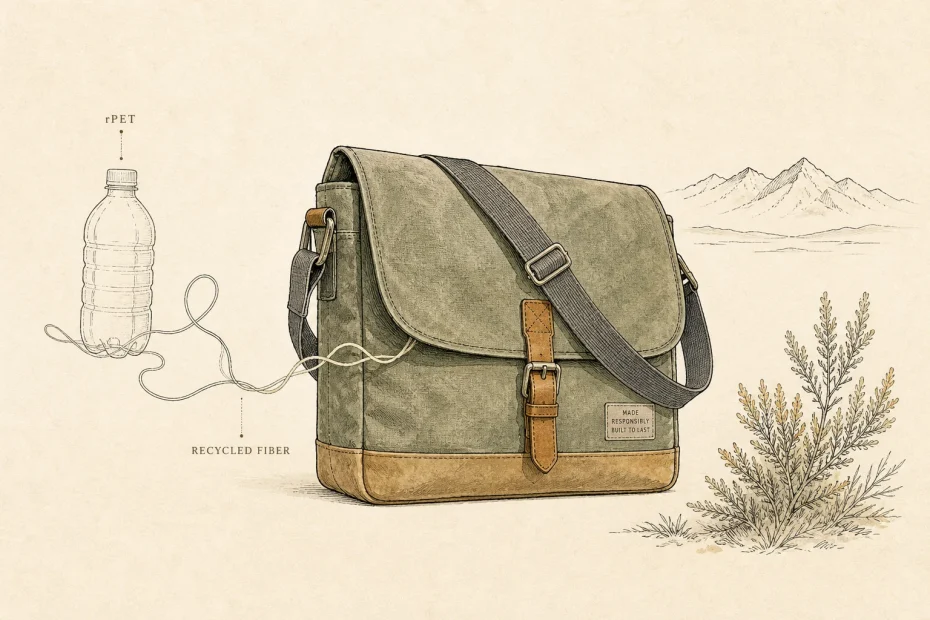
Every year the world discards 92 million tonnes of textiles — the equivalent of a rubbish truckload of clothing burned or buried every single second — while billions of plastic bottles wait in recycling bins for a second life. A recycled messenger bag is where those two problems meet: one well-made bag can carry your laptop for a decade and keep the equivalent of a stack of plastic bottles out of the waste stream. This guide covers how recycled bags are made, what they actually save, how they compare with leather and canvas, and which ones are worth carrying in 2026.
Recycled Messenger Bags: How Plastic Bottles Become Bags That Last
Related Topics You May Find Helpful
If you are shopping for a sustainable messenger bag, these are the questions most people end up asking. Jump straight to the one that matters to you:
- How a plastic bottle becomes a messenger bag (the science)
- What a recycled bag really saves (the numbers)
- Recycled fabric vs. leather vs. canvas (the comparison)
- Durability, waterproofing and care (the longevity guide)
- How to spot real recycled claims (the trust check)
- Four recycled messenger bags worth carrying in 2026
How a Plastic Bottle Becomes a Messenger Bag
Recycled messenger bags are made from polyethylene terephthalate (PET) — the same plastic as single-use water bottles — which is cleaned, melted and re-spun into polyester fiber. That fiber is called rPET, short for recycled polyethylene terephthalate, and it is the most common recycled material in bags today.
The journey takes about six steps: bottles are collected and sorted, washed and shredded into flakes, melted into chips, extruded into ultra-thin fibers, spun into yarn, and finally woven or knitted into fabric that is cut and sewn into a bag. Because the plastic is melted and reformed rather than made from crude oil, rPET skips the most energy-hungry part of polyester production.
Here is the entertaining part. Industry estimates put the conversion at roughly 10 plastic bottles per pound (0.45 kg) of polyester fiber, and about 9 bottles per t-shirt. Do the math on a mid-size messenger bag, which typically uses 1.5–2 lb (0.7–0.9 kg) of shell fabric: the bag on your shoulder can represent 15–25 bottles that never reached a landfill or an ocean. The same material science explains why rPET is not a niche curiosity — the global recycled polyester market was valued at USD 15.52 billion in 2024 and is projected to reach USD 26.18 billion by 2030 (Grand View Research) .
The Short Version: A recycled messenger bag starts as PET plastic bottles that are washed, melted and re-spun into polyester fiber called rPET. Roughly 10 bottles make 1 lb (0.45 kg) of fabric, so a typical mid-size bag represents 15–25 bottles diverted from waste. It is the same plastic, given a second, longer life.
What a Recycled Messenger Bag Actually Saves
Choosing recycled polyester over virgin polyester cuts greenhouse gas emissions by roughly 70%, according to Textile Exchange guidance based on Sustainable Apparel Coalition data (Textile Exchange) , and it uses about 59% less energy during production (Sew Dynamic) . Those are the two numbers that matter most when comparing bags.
The context is sobering: only about 9% of all plastic waste ever generated has been recycled, with the rest incinerated or landfilled (ScienceDirect) , and an estimated 11 million tonnes of plastic still enter the world’s oceans every year (UN Environment Programme) . Meanwhile, the fashion industry produces 92 million tonnes of textile waste annually — a figure projected to reach 134 million tonnes by 2030 (UNEP) .
Buyers are responding. The eco-friendly bag market was worth USD 1,525.2 million in 2023 and is projected to reach USD 2,664.3 million by 2031, a compound annual growth rate of 6.1% (Verified Market Research) . Even so, recycled polyester still represents only about 12% of the polyester market, which is why industry initiatives such as the Recycled Polyester Challenge push brands to source 45–100% of their polyester from recycled inputs (Textile Exchange) .
| Factor | Recycled polyester (rPET) | Virgin polyester |
|---|---|---|
| Feedstock | Post-consumer plastic bottles and textile waste | Crude oil |
| Production greenhouse gas emissions | Roughly 70% lower | Baseline |
| Production energy use | About 59% less | Baseline |
| Waste diverted | Yes — bottles and scraps get a second life | None |
| Market share of polyester (2024) | ~12% | ~88% |
What This Means for Your Carbon Footprint: A recycled messenger bag cuts production emissions by roughly 70% and energy use by about 59% compared with virgin polyester, while diverting 15–25 bottles from waste. The caveat: recycled polyester is still only ~12% of the polyester market, so verifying a bag’s recycled content matters.
Recycled messenger bags versus virgin-material bags
The material comparison has an environmental point at the center: the recycled bags turn the plastic bottles and the textile waste into the durable carry, and the impact difference is real. The conversations are consistent — the recycled materials save the resources and the waste, while the virgin materials offer the familiar feel, and the modern recycled fabrics close the quality gap.
Factor Recycled material Virgin material Environmental impact Lower Higher Durability Modern fabrics hold up Established Feel Woven, technical Traditional Story Visible impact None The practical advice: check the recycled content claim and the construction quality, since the label alone does not guarantee the durability — the good recycled bags match the virgin-material standards. The bag that works is the one that carries well and lasts, whatever the source. The recycled choice that matters is the one built to be used for years.
Recycled Fabric vs. Leather vs. Canvas: Which Messenger Bag Material Is Best?
For daily commuters, recycled polyester and recycled canvas beat conventional leather on weight, weather resistance, and waste diverted, while premium leather still wins on long-term repairability and traditional style. There is no single “best” — the right choice depends on how you carry.
- Recycled polyester (rPET) — lightweight, dries fast, packs well; waterproofing depends on a coating or liner. Best for bike commuters and travelers.
- Recycled tarp canvas — upcycled truck tarps built for weather exposure; heavier, more textured, each bag unique. Best for those who want character and ruggedness.
- Organic cotton canvas — natural, breathable, biodegradable at end of life, but heavier when wet and needs waxing for serious rain. Best for a classic, casual look.
- Conventional leather — ages beautifully and can be repaired for decades, but tanning is resource-intensive and animal-based. Best for a dressier, long-term investment piece.
- PU “vegan leather” — often plastic-based with variable durability; check the backing and brand reputation before trusting the label. Best avoided for heavy daily use.
| Material | Durability | Weather resistance | Eco profile | Typical price |
|---|---|---|---|---|
| Recycled polyester (rPET) | High (Cordura-grade weaves) | Water-resistant; waterproof with TPU liner | Diverts bottles, ~70% lower GHG than virgin | $30–$140 |
| Recycled tarp canvas | Very high (truck-grade) | Excellent by design | Upcycles industrial waste | $80–$150 |
| Organic cotton canvas | Medium-high | Low unless waxed | Renewable, biodegradable | $25–$90 |
| Conventional leather | Very high, repairable | Medium; needs conditioning | Resource-intensive tanning | $100–$300+ |
| PU vegan leather | Variable | Medium | Plastic-based; check claims | $25–$80 |
The Takeaway: Recycled polyester is the best all-round commuter choice — light, weather-ready with a TPU liner, and roughly 70% lower production emissions than virgin polyester. Recycled tarp canvas wins on rugged character, and leather only beats both if you prioritize repairability and formal style over weight and waste.
How Long Do Recycled Messenger Bags Last? Durability, Waterproofing and Care
A well-made recycled messenger bag lasts 5–10 years of daily use, and the three factors that decide that lifespan are the weave or denier of the fabric, the quality of the hardware, and how you care for it. Denier is simply the thickness of the fiber — higher numbers mean tougher fabric.
Look for specific engineering rather than vague “eco” language. The Timbuk2 Classic Messenger, for example, pairs a weatherproof shell of Eco Cordura made from recycled pre- and post-consumer materials with a waterproof 70-denier TPU liner, an aircraft-grade aluminum buckle and an OrthoLite foam strap. Truck-tarp canvas bags such as the handcrafted Iguape are made from materials originally built to survive weather on the road. Even budget-conscious picks like the Kenneth Cole Recycled Polyester Slim Briefcase add a padded laptop compartment, eight storage pockets and a cable passthrough — at 15.5 x 11.5 x 3 in (39 x 29 x 8 cm) and 1.5 lb (0.7 kg).
Waterproofing deserves a straight answer: rPET fabric is not waterproof on its own. It becomes water-resistant or waterproof only through a coating, a laminate, or a liner (TPU is the most common). If rain is part of your commute, choose a bag that states its weather protection explicitly, or re-apply a durable water repellent (DWR) spray once a year.
- Spot clean with a damp cloth and mild soap for everyday marks.
- Machine wash cold on a gentle cycle only if the label allows it; never use hot water.
- Always air dry — polyester softens and distorts around 250°C (482°F), so high heat from dryers or irons is the enemy.
- Re-waterproof annually with a DWR spray designed for synthetics.
- Fix, don’t replace — brands like Timbuk2 back their bags with a lifetime warranty, which is the single strongest durability signal a brand can give (Timbuk2) .
Care in 30 Seconds: Recycled messenger bags last 5–10 years when the fabric, hardware and care are right. rPET is not automatically waterproof — check for a TPU liner or coating. Spot clean, machine wash cold, air dry, and re-apply DWR yearly. A lifetime warranty is the best durability guarantee you can get.
How to Spot Real Recycled Claims (and Avoid Greenwashing)
You can verify a recycled claim in about two minutes: look for a third-party certification, demand the exact recycled percentage, and check whether the brand names its material sources. Vague words like “eco” or “green” without specifics are the first red flag.
- Global Recycled Standard (GRS) — verifies recycled content and responsible production across the supply chain; brands like Toad&Co certify their rPET fibers this way (Toad&Co) .
- bluesign — screens chemicals and resource use at every production step, a strong signal for outdoor-gear-grade fabrics.
- OEKO-TEX Standard 100 — confirms no harmful substances in the finished product; relevant for bags you carry against your body daily.
- Specific recycled content — a real claim reads “100% recycled polyester exterior” or “made from recycled pre- and post-consumer materials,” not “environmentally friendly.”
Reality-check the market, too: recycled polyester held only about 12% of the polyester market in 2024 (ASI) , so a brand that says it is “fully recycled” deserves a follow-up question about how much of the bag is actually recycled fiber. Fewer than 1% of textiles are currently recycled into new clothing (Ellen MacArthur Foundation) , which makes verifiable claims more valuable — and more rare — than they should be.
The Trust Check: Real recycled claims carry third-party proof: GRS for recycled content, bluesign for clean production, OEKO-TEX for safety — plus an exact percentage. Be suspicious of “eco” without specifics, and remember that recycled polyester is only ~12% of the market, so verification separates genuine bags from greenwashing.
4 Recycled Messenger Bags Worth Carrying in 2026
Here is the part that surprises most shoppers: the best recycled messenger bags available right now are not the cheapest ones — they are the bags that pair certified recycled materials with a waterproof liner and a padded laptop sleeve, because those are the features that keep a bag out of the landfill for a decade. All four picks below were verified as live, in-stock listings on Amazon in August 2026, with the material claims checked directly on each product page.
1. Timbuk2 Classic Messenger Bag — the icon, rebuilt from recycled Eco Cordura
The bag that defined the messenger category now comes in a version made with Eco Cordura from recycled pre- and post-consumer materials. It pairs a weatherproof exterior with a waterproof 70-denier TPU liner, fits 13-inch, 15-inch and 17-inch (33, 38 and 43 cm) laptops, and carries a 4.6-star rating from thousands of owners. The lifetime warranty is the clincher: this is a buy-it-for-years bag, priced at about 140.
2. Kenneth Cole Recycled Polyester Slim 16″ Laptop Briefcase — the office pick
Kenneth Cole’s slim briefcase is built around an explicit sustainability bullet: a recycled polyester exterior with a tear-resistant lining. The padded compartment fits up to a 16-inch (41 cm) laptop, eight pockets organize cables, pens, and tech, and a trolley tunnel lets it ride on a suitcase. At 15.5 x 11.5 x 3 in (39 x 29 x 8 cm) and 1.5 lb (0.7 kg), it is the lightest professional option here, rated 4.3 stars and priced about 50.
3. Sling rePETe + Refine Eco-Friendly Messenger-Style Tote — the everyday value
Named for the very material it is made from — rePETe is rPET, recycled polyethylene terephthalate — this messenger-style tote is the affordable entry point into recycled bags. It folds into a reusable carry that works for workdays, market runs,s and travel, and its 4.6-star rating shows owners keep coming back. At around 20 it is the lowest-cost way to test the recycled-bag habit.
4. Iguape Recycled Tarp Canvas Messenger — the handcrafted original
Handcrafted in Brazil from recycled truck tarps, the Iguape messenger is proof that one bag can be both waste-diverting and one-of-a-kind. Each piece keeps the tarp’s weatherproof character, measures 11.5 x 14 in (29 x 36 cm), and offers front and inside pockets. It is the artisan pick for people who want their bag to have a story, priced at about 130 with a 4.3-star rating.
| Bag | Recycled material | Laptop fit | Weather protection | Rating | Price | |
|---|---|---|---|---|---|---|
| Timbuk2 Classic Messenger | Eco Cordura (recycled pre/post-consumer) | 13″–17″ (33–43 cm) | Waterproof TPU liner | 4.6 | ≈140 | View on Amazon |
| Kenneth Cole Slim Briefcase | Recycled polyester exterior | 16″ (41 cm) | Water-resistant | 4.3 | ≈50 | View on Amazon |
| Sling rePETe + Refine Tote | rPET (recycled bottles) | No sleeve | Reusable tote | 4.6 | ≈20 | View on Amazon |
| Iguape Tarp Canvas Messenger | Recycled truck tarps | No sleeve | Weatherproof by design | 4.3 | ≈130 | View on Amazon |
How to Choose the Right Recycled Messenger Bag: A 2026 Buying Checklist
The best sustainable messenger bag is the one you still carry in five years. Work through this checklist before you buy, whether the bag is for your commute, campus, or the trail.
- Verify the material claim. Look for GRS, bluesign, or OEKO-TEX certification, and an exact recycled percentage. No specifics, no sale.
- Match the laptop sleeve to your machine. Sizes run 13, 15 and 17 in (33, 38, 43 cm); measure your laptop before choosing.
- Check weather protection honestly. If rain is part of your commute, you want a stated TPU liner, coated fabric or waxed finish — not an assumption.
- Inspect the hardware. Metal buckles, YKK-class zippers and reinforced stitching predict lifespan better than any label.
- Think in years, not seasons. A lifetime warranty and repairable design beat a lower price every time.
- Mind the weight. A professional briefcase around 1.5 lb (0.7 kg) carries comfortably; heavier tarp bags trade weight for character.
- Support local and artisan makers where you can. Regionally made bags shorten shipping miles and keep craft traditions alive — the same philosophy behind Montana-made gear and accessories.
Frequently Asked Questions
Are messenger bags made from recycled materials durable?
Yes, when the fabric and construction are right. Cordura-grade recycled polyester is abrasion-resistant, recycled truck tarps were built for road weather, and the four bags verified for this guide all carry customer ratings between 4.3 and 4.6 stars. Durability comes from the weave, the hardware,e and the care routine, not from whether the material is recycled.
Is recycled polyester waterproof?
Not on its own. rPET fabric is water-resistant at best; it becomes waterproof when a bag adds a TPU liner or laminate, as the Timbuk2 Classic does. If you commute in rain, buy a bag that states its weather protection explicitly and re-apply a DWR spray once a year.
How many plastic bottles does it take to make a messenger bag?
Roughly 10 bottles produce 1 lb (0.45 kg) of polyester fiber, and a t-shirt takes about 9 bottles. A mid-size messenger bag uses 1.5–2 lb (0.7–0.9 kg) of shell fabric, so the bag on your shoulder represents roughly 15–25 bottles that were diverted from waste — an estimate based on the standard conversion cited by recycled-fiber producers.
What does rPET mean?
rPET stands for recycled polyethylene terephthalate — plastic bottles and other PET waste that has been cleaned, melted and re-spun into polyester fiber. It is the most common recycled material in bags, backpacks and outdoor gear.
How do you clean a recycled fabric messenger bag?
Spot clean with mild soap for everyday marks. If the label allows, machine wash cold on a gentle cycle and always air dry — polyester distorts near 250°C (482°F), so dryers and hot irons shorten a bag’s life. Re-apply a DWR spray yearly to keep water beading.
Can a recycled messenger bag fit a laptop?
Yes. Padded laptop compartments are standard on commuter models, sized for 13-inch, 15-inch and 17-inch (33, 38 and 43 cm) machines — the Kenneth Cole briefcase even fits a 16-inch (41 cm) laptop. Tote-style recycled bags may skip the sleeve, so check the listing.
How can I tell if a bag is really made from recycled materials?
Ask three questions: Is there a third-party certification (GRS, bluesign, OEKO-TEX)? What percentage of the bag is recycled content? Does the brand name its materials and suppliers? Vague “eco” language without specifics is the classic greenwashing pattern.
Are recycled bags better for the environment than leather bags?
It depends on your metric. Recycled polyester cuts production emissions by roughly 70% versus virgin polyester and diverts plastic waste, but it remains a synthetic fiber. Leather lasts decades when repaired, yet tanning is resource-intensive. The most sustainable bag is the one you buy once and use for years — verified recycled materials plus a lifetime warranty is a strong combination.
What we covered
- Recycled polyester cuts production greenhouse gas emissions by roughly 70% and energy use by about 59% compared with virgin polyester (Textile Exchange, Sew Dynamic).
- About 10 plastic bottles make 1 lb (0.45 kg) of polyester fiber; a typical messenger bag represents 15–25 bottles diverted from waste.
- The global recycled polyester market was USD 15.52 billion in 2024 and is projected to reach USD 26.18 billion by 2030 — a 9.25% CAGR (Grand View Research).
- Only about 9% of all plastic ever produced has been recycled, and 92 million tonnes of textile waste are generated every year (ScienceDirect, UNEP).
- Recycled polyester still accounts for only ~12% of the polyester market, so certifications (GRS, bluesign, OEKO-TEX) and exact recycled percentages are how you separate real claims from greenwashing.
- The most sustainable messenger bag is the one you carry for 5–10 years: verified recycled materials, a waterproof liner, quality hardware — and a lifetime warranty where you can get it.
Sources
- UN Environment Programme — Textile waste and fast fashion
- Ellen MacArthur Foundation — Fashion and the circular economy
- ScienceDirect — Closing the PET plastic recycling loop
- UN Environment Programme — Plastic pollution in oceans
- Textile Exchange — Recycled polyester guidance (70% GHG reduction)
- Sew Dynamic — Virgin vs. recycled polyester (59% less energy)
- Grand View Research — Recycled polyester market report
- Verified Market Research — Eco-friendly bag market
- Textile Exchange — 2025 Recycled Polyester Challenge
- ASI — The promise and limitations of recycled polyester
- Night Fox Designs — Bottles-to-fabric conversion estimate
- Toad&Co — GRS-certified rPET fibers
- Timbuk2 — Sustainability and lifetime warranty