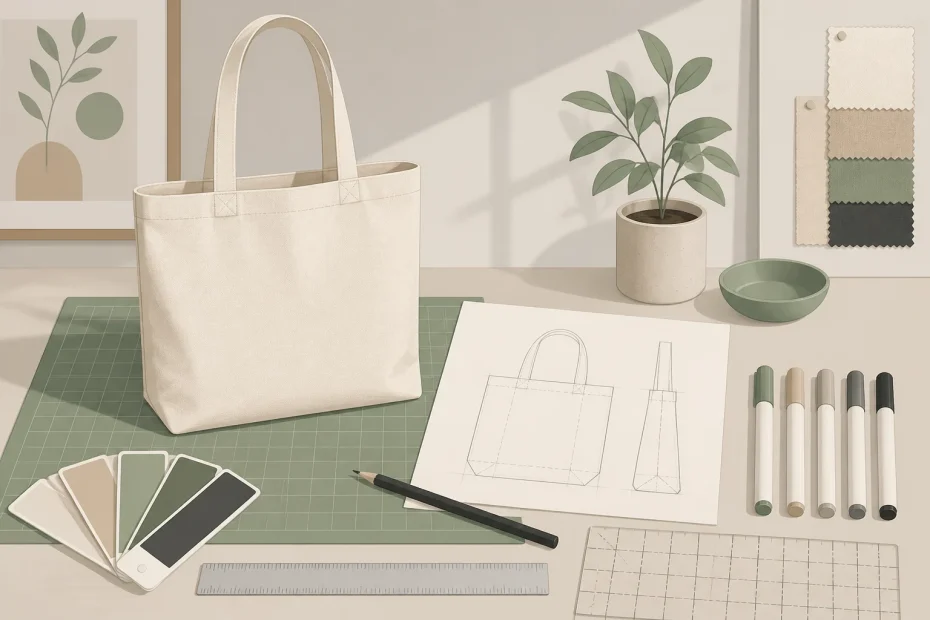
Designing your own bag sounds like a job for a fashion house, but a custom tote is one of the most beginner-friendly design projects there is — a blank canvas of cotton you can turn into something personal in an afternoon. This guide walks through the four elements of bag design, the materials that matter, and exactly how to get your artwork onto the finished product.
Bag Design for Beginners: How to Design a Custom Tote From Sketch to Finished Bag
Disclosure: This article contains product links, and we may earn a commission from qualifying purchases made through them, at no extra cost to you.
Bag design is the process of turning an idea into a functional carry — and at its core it rests on four decisions: what the bag will do, what it will look like, what it is made of, and how it is put together. The bag-making educator Klum House frames these as the four elements of bag design, and the order matters: function first, then form, then materials, then construction (Klum House, The 4 Elements of Bag Design). Start with a clear answer to “how will this bag be used?” and every later decision gets easier.
The Four Elements of Bag Design
Every bag — a tote, a messenger, a purse, a backpack — is the result of the same four design elements: functionality, aesthetics, materials, and construction. Functionality asks what the bag carries and how it is carried: a petite crossbody purse and a large hiking pack are different products because their functions differ, not because of decoration. Aesthetics covers silhouette, color, and proportion. Materials determine weight, durability, and feel. Construction — the seams, edges, and hardware — decides whether the bag survives daily use.
The practical design method is to answer them in order. Define the use case first (work commute, farmers market, travel), then the look you want, then the material that fits both, then how it will be sewn or assembled. This sequence is also what makes custom bag design accessible to beginners: you can change materials and colors freely, but the bag only works if the function and construction are sound.
The Short Answer
Bag design rests on four elements: functionality (how the bag is used and carried), aesthetics (silhouette, color, proportion), materials (weight, durability, feel), and construction (seams, edges, hardware). Answer them in that order — function first. A custom tote is a beginner-friendly project because the first three elements are easy to customize; the fourth, construction, is what makes the bag last.
Materials: What to Design On
Material choice is the single biggest factor in how a bag feels, how long it lasts, and how it takes a design. Cotton canvas is the default for custom totes because it is strong, breathable, and accepts paint, markers, and printing well. Canvas weight matters: 8 oz cotton (about 270 g/m²) is light and soft, ideal for everyday casual totes, while 10–12 oz canvas (340–405 g/m²) is heavier-duty and holds its shape under load (EPA, Ten Ways to Unpackage Your Life). Natural cotton is recyclable in the sense that it is biodegradable and reusable, which is why canvas totes are a staple of sustainable carry.
| Material | Weight range | Best for | Design methods |
|---|---|---|---|
| Light cotton canvas | 8 oz (270 g/m²) | Everyday casual totes, DIY painting | Fabric markers, paint, stencils |
| Heavy cotton canvas | 10–12 oz (340–405 g/m²) | Grocery, work, daily carry | Screen printing, heat transfer, markers |
| Leather / vegan leather | Variable | Purses, premium messengers | Tooling, stamping, edge paint |
| Recycled / synthetic textile | Variable | Outdoor and technical bags | Printing, embroidery |
For a first custom project, a blank 8 oz cotton tote is the sweet spot: cheap enough to experiment on, sturdy enough to use daily, and the best surface for fabric markers and paint. Heavier 10–12 oz canvas is the right choice when the bag will carry real weight — groceries, books, tools — and you want it to keep its shape for years.
Bag design basics: the custom tote
Bag design discussions have a foundation at the center: the custom tote is designed on the four elements. The conversations are consistent — the bag design for the beginners — the form, the function, the materials, and the construction — creates the custom pieces, and the four elements cover the process.
The practical advice: learn the four elements of the bag design — the form for the shape, the function for the use, the materials for the durability, and the construction for the build — and apply them to the custom tote. The design that works is the one where the elements balanced. The custom tote that succeeds is the one built on the basics.
Key Facts at a Glance
Cotton canvas is the standard custom-tote material: 8 oz (270 g/m²) for light everyday bags, 10–12 oz (340–405 g/m²) for heavy-duty carry. Heavier canvas holds shape under load and lasts longer; lighter canvas is easier to decorate and folds away. Natural cotton is biodegradable and reusable, making canvas a core sustainable-carry material.
How to Get Your Design Onto the Bag
There are four practical routes from artwork to finished bag, and the right one depends on your skills, budget, and how many bags you need. Fabric markers are the most accessible: acrylic fabric pens draw directly on canvas, and quality sets are permanent after heat-setting (ironing) and hold up to washing. Fabric paint and stencils suit bigger, bolder graphics. Heat-transfer or iron-on designs work when you have a printed image. And for quantities of ten or more, custom printing services — online or local — handle upload, placement, and production for you.
- Fabric markers (1–3 bags): draw directly on canvas; heat-set with an iron; best for hand-drawn art and lettering.
- Fabric paint + stencils (1–5 bags): bold blocks of color and repeat patterns; use painter’s tape for clean edges.
- Heat transfer / iron-on (1–10 bags): print your design, transfer with heat; good for photographic or multi-color art.
- Custom printing service (10+ bags): upload your file, choose placement, and the printer handles production; ideal for events and businesses.
File preparation matters for printing routes: save vector or high-resolution files (PDF or TIFF), include a bleed area if the design runs to the edge, and check the printer’s template for panel boundaries — some designs must not cross seams or the bag’s gusset.
Design Transfer Options
Fabric markers suit 1–3 handmade bags; paint and stencils suit bolder graphics; heat transfer works for printed images; custom printing services handle batches of 10 or more. For print files, use high-resolution PDF or TIFF with bleed, and respect panel and seam boundaries. Heat-set marker and paint designs with an iron to make them wash-fast.
Design Questions to Answer Before You Start
Asking the right questions before you design saves hours of rework. The core checklist, drawn from common custom-bag questions, is short: How will the bag be used? What size does it need to be? Do you want one bag or many? Are you using natural or synthetic materials? And how will the bag be cleaned? Each answer narrows the design space — a beach tote and a work tote need different sizes, materials, and strap designs, even if the silhouette looks similar.
For a custom tote specifically, decide on the straps early: short handles suit hand-carry, long shoulder straps suit heavy loads, and a 24 in (61 cm) shoulder strap with a 12 in (30 cm) short handle covers both cases. Then choose colors and placement, sketch or mock it up, and test your design on a scrap piece of the same fabric before committing to the final bag.
Pre-Design Checklist
Answer these before designing: use case (what carries, how carried), size (dimensions in inches and centimeters), quantity (one-off or batch), materials (natural or synthetic), and care (washing method). Choose straps by load: short handles for hand-carry, long shoulder straps for heavy loads. Mock up on scrap fabric first, then produce the final bag.
Related Topics You May Find Helpful
How do I choose the best design for a custom tote bag? Match the design to the use case: bold graphics for casual totes, clean minimal lettering for work and corporate, and durable materials plus reinforcement for heavy-carry bags.
How do I clean a cotton tote bag? Machine wash on cold and air dry to protect the fabric and any painted or printed design; hot water and machine drying are the two biggest causes of fading and shrinkage in decorated canvas.
Are canvas tote bags recyclable? Natural cotton canvas is biodegradable and can be composted or repurposed at end of life, which is why reusable canvas totes are a staple of sustainable carry; the EPA notes each reusable bag can replace hundreds of single-use bags (EPA, Ten Ways to Unpackage Your Life).
Can I order just one personalized tote bag? Yes — fabric markers, paint, and heat transfer all work on a single bag, and some printing services offer single-unit custom orders; one-off DIY is the most affordable route.
What are custom purses made from? Custom purses are typically made from leather or vegan leather, structured textiles, or canvas; the material determines the bag’s weight, durability, and price.
What we covered
- Bag design = functionality + aesthetics + materials + construction, answered in that order.
- 8 oz cotton canvas (270 g/m²) is the beginner-friendly custom-tote material; 10–12 oz (340–405 g/m²) is the heavy-duty choice.
- Fabric markers are the most accessible decoration method; heat-set designs with an iron for wash-fastness.
- Choose straps by load: short handles for hand-carry, long shoulder straps for heavy loads.
- Test your design on scrap fabric before committing to the final bag.
- Natural cotton canvas is biodegradable and reusable — a core sustainable-carry material.
Featured Products for Your Bag Design Project
These verified products cover the full beginner workflow — blank canvas to design on, and fabric markers to bring the design to life. All links open in a new tab.
| Product | Use in your project | Current price |
|---|---|---|
| Phicorn Blank Canvas Tote Bags, 15 x 16 in (38 x 41 cm), 8 oz cotton | Single-bag DIY projects; the ideal blank surface for markers and paint | About $6 |
| Carbrea 12-Pack Thin Canvas Tote Bags | Batch projects, events, or practice runs | About $17 |
| ARTISTRO 36-Piece Fabric Markers | Full-color hand-drawn designs, permanent on fabric | About $14 |
| Pagather 20-Color Dual-Tip Fabric Markers | Budget starter set for totes and t-shirts | About $9 |
| LINICE 3-Pack Heavy-Duty Canvas Grocery Totes (12 oz) | Finished heavy-duty carry with shoulder and short handles | About $18 |
- Start with a blank 8 oz cotton canvas tote and make it yours
- Stock up on 12 blank totes for a batch design project
- Bring your design to life with a 36-color fabric marker set
- Try a budget 20-color dual-tip marker set for your first bag
- Skip straight to a finished heavy-duty canvas tote for daily use
Disclosure: This article contains sponsored content and product links. If you make a purchase through the links in this post, we may earn a commission at no extra cost to you. Product evaluations are based on published specifications and general product-class principles; we have not personally tested every item featured.
FAQ
What is the first step in bag design? Define the use case: what the bag carries, how it is carried, and where it is used. Function drives every later decision about size, material, and straps.
Do fabric markers wash off tote bags? Quality acrylic fabric markers are permanent after heat-setting — iron the design on the reverse side — and hold up to cold-water washing; hot water and machine drying cause the most fading.
What size should a custom tote bag be? A standard reusable tote is roughly 15 x 15 in (38 x 38 cm) with a 10–12 in (25–30 cm) handle drop; grocery and work totes are larger, and evening or travel totes vary by use.
Can I design a bag without sewing skills? Yes — decorating a blank tote with markers, paint, or heat transfer requires no sewing; sewing or assembly is only needed if you start from raw fabric and build the bag yourself.
How do I design a tote for a business or event? Use a custom printing service: upload a high-resolution PDF or TIFF with bleed, choose placement on the template, and order in bulk for the best per-bag price.