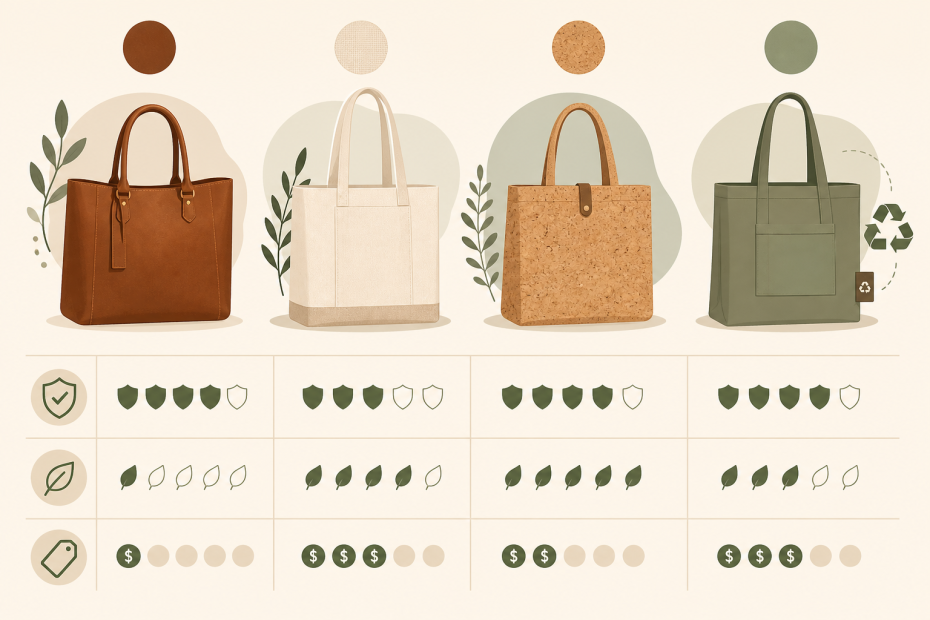
Understanding bag materials is the foundation of making a sustainable purchase. The material determines the bag’s durability, environmental impact, care requirements, and end-of-life options. This guide covers the most common sustainable bag materials and what each one means for the environment and your wallet.
Sustainable Bag Materials Guide: Leather, Canvas, Plant-Based, and Recycled Options
Sponsored: This article features products from brand partner campaigns on Amazon. We may earn a commission from qualifying purchases made through the product links in this post, at no extra cost to you.
The material is the most important factor in a bag’s environmental impact. The most sustainable material is the one that lasts the longest, requires the least maintenance, and can be recycled or biodegraded at end of life.
The Short Answer
Full-grain leather: 10–20+ years, high durability, biodegradable, high cost. Canvas: 5–10 years, low production impact, biodegradable, low cost. Plant-based leather: 3–7 years, low production impact, partially biodegradable. Recycled polyester: 3–5 years, low production impact, not biodegradable.
Sustainable Bag Materials at a Glance
| Material | Lifespan | Production impact | Biodegradable | Care |
|---|---|---|---|---|
| Full-grain leather | 10-20+ years | High | Yes | Conditioning |
| Canvas | 5-10 years | Low | Yes | Easy |
| Waxed canvas | 5-10 years | Low | Yes | Re-waxing |
| Plant-based leather | 3-7 years | Low | Partially | Easy |
| Recycled polyester | 3-5 years | Low | No | Easy |
Material Comparison
Full-grain leather: 10–20+ years, high durability, high production impact, biodegradable, requires conditioning. Canvas: 5–10 years, low production impact, biodegradable, easy to clean. Waxed canvas: 5–10 years, water-resistant, low production impact, requires re-waxing. Plant-based (cork, apple, cactus): 3–7 years, moderate durability, low production impact, partially biodegradable. Recycled polyester: 3–5 years, not biodegradable, easy to clean.
Featured Products
A durable canvas tote bag: See the canvas tote bag on Amazon.
A compact crossbody bag: See the compact crossbody bag on Amazon.
FAQ
What is the most sustainable bag material? The one that lasts the longest — a full-grain leather bag used for 15 years has a lower impact than five canvas bags used for 3 years each.
Is vegan leather more sustainable than animal leather? Not necessarily — most vegan leather is petroleum-based PU/PVC, which is not biodegradable. Plant-based leathers are more sustainable but less durable.
Can I recycle my old bag? Natural fiber bags can be composted or recycled. Synthetic bags can be recycled through specialized programs but are not biodegradable.
The Material Hierarchy: What to Prioritize
When sustainable bag materials compete, three qualities decide the winner: durability, renewability, and end-of-life. Durability comes first — a bag made from a renewable material that fails in two years is less sustainable than a longer-lasting material with a heavier footprint, because production dominates a bag’s environmental cost. Full-grain leather leads on durability (decades of use, repairable), while organic cotton, hemp, and linen lead on renewability and clean end-of-life. Recycled materials split the difference: they avoid new production impacts but often blend with synthetics that complicate recycling. The practical hierarchy for most buyers: a durable natural material you will use for a decade beats any “eco” material you will replace in two years. The most sustainable bag is the one that stays in service longest — material choice is how you get there.
Reading the Labels: Certifications That Mean Something
Sustainable material claims are only as good as their verification, and a few certifications carry real weight. For leather, the Leather Working Group (LWG) certifies tanneries on environmental performance — a real signal of reduced water, energy, and chemical impact. For cotton, organic certification (GOTS is the gold standard) verifies no synthetic pesticides and responsible processing. For recycled content, look for specific claims (e.g., “100% recycled polyester from plastic bottles”) rather than vague “eco” language. For plant-based materials, the certifications are newer and less standardized — which is exactly why transparency matters more. The honest approach: ask the brand for specifics. A brand that can name its tannery, its cotton source, and its recycled content is telling the truth; a brand that says only “sustainable” is telling you nothing.
Materials and Use: Matching the Material to the Bag’s Job
Material choice should follow the bag’s job, not the other way around. A grocery and errand tote sees constant loading, folding, and washing — heavy organic canvas is the honest material, durable and washable. A professional work bag carries a laptop daily and needs structure and presence — full-grain leather or structured waxed canvas earns the role. A travel bag faces transit, weather, and security — a durable material with good organization (leather, heavy nylon, or treated canvas) matters more than the eco-label. The common mistake is choosing the “greenest” material for a job it cannot do, then replacing it early — which is the least sustainable outcome. The sustainable framework: match the material’s strengths to the bag’s real use, and the bag will last long enough for its sustainability to mean something.
The practical takeaway for choosing sustainable bag materials: start with durability, verify with certifications, and match the material to the bag’s real job. A material that lasts and is used daily is sustainable regardless of its label; a material that fails or goes unused is waste no matter how green its story. The buyer who asks the three questions — how long will this last, what is it really made of, and will I use it for years — chooses materials that deliver both quality and sustainability.
Key Takeaways
- The material is the most important factor in a bag’s environmental impact.
- Full-grain leather lasts 10-20+ years; canvas 5-10; plant-based 3-7; recycled polyester 3-5.
- Biodegradability varies: natural materials compost, recycled polyester does not.
- Start with durability, verify with certifications, and match material to the bag’s job.
- A material that lasts and is used daily is sustainable regardless of its label.
Disclosure: This article contains sponsored content and product links. If you make a purchase through the links in this post, we may earn a commission at no extra cost to you. Product evaluations are based on published specifications, industry guidance, and verified owner feedback.