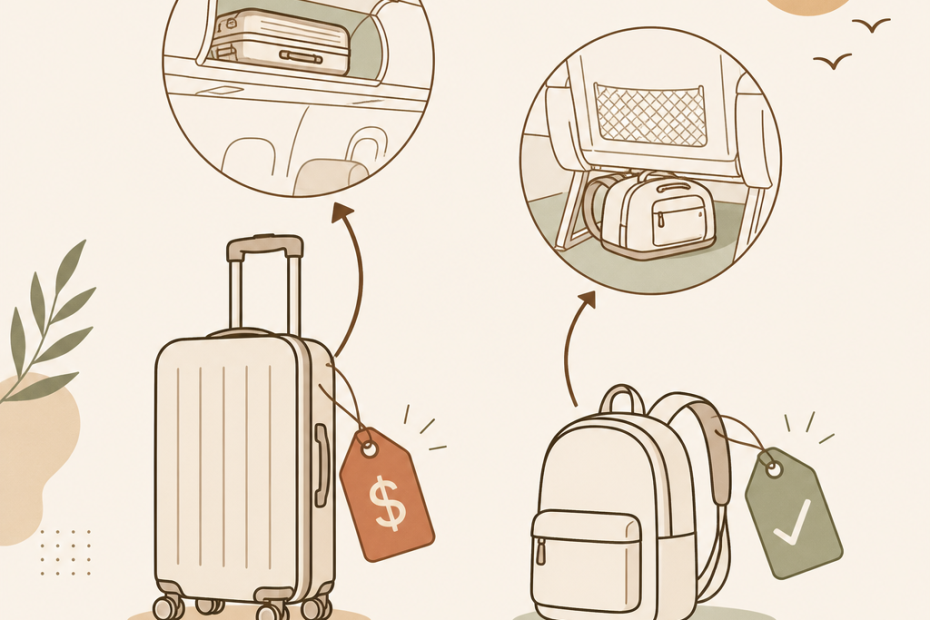
Every flight includes two pieces of luggage that cost you nothing—if you pack them correctly. The carry-on and the personal item have different jobs, size limits, and fees. Mixing up their roles is the most common (and most expensive) packing mistake travelers make. This guide lays out a clear system for dividing your belongings between the two bags, what belongs in each, and how to avoid the gate fees that catch thousands of passengers every day.
Carry-On vs. Personal Item: The Bag Role System That Avoids Fees
Sponsored: This article contains product links. We may earn a commission on qualifying purchases at no extra cost to you.
The Two Bags Have Different Jobs — Pack Them That Way
The carry-on and the personal item are not two versions of the same bag. They are a two-part system with distinct roles:
The carry-on holds your trip’s bulk: clothing, shoes, toiletries, and gear. It goes in the overhead bin and may cost extra on budget airlines. Size limit: typically 22 x 14 x 9 inches (56 x 36 x 23 cm).
The personal item holds what you need during the flight and what you cannot afford to lose: passport, phone, medications, valuables, and a change of clothes. It goes under the seat and is free on every airline. Size limit: typically 18 x 14 x 8 inches (46 x 36 x 20 cm).
The rule: if you would panic about losing it, it goes in the personal item. Everything else goes in the carry-on.
Summary: The carry-on holds trip bulk (overhead bin, may cost extra); the personal item holds flight essentials and valuables (under the seat, always free). Pack by role, not by what fits.
The Fee Trap on Budget Airlines
Budget carriers charge for carry-ons but include a free personal item. On Frontier, Spirit, Ryanair, and similar airlines, a carry-on costs $30 to $80 per flight segment — while a personal item within their size limits boards free. This creates the single most effective money-saving strategy in air travel: if you can fit your trip in a personal-item-sized bag (18 x 14 x 8 inches), you eliminate the carry-on fee entirely.
The Lossga 18x14x8 travel backpack (see the 18x14x8 backpack) is sized specifically for budget-airline personal item limits. The ECOHUB airline-approved personal item bag (browse the ECOHUB personal item bag) offers the same sizing with organized compartments.
Fee comparison by airline type:
| Airline type | Carry-on | Personal item | Strategy |
|---|---|---|---|
| Full-service (Delta, United, AA) | Included | Included | Use both bags |
| Budget (Frontier, Spirit) | $30-80 fee | Free | Personal item only |
| European budget (Ryanair, Wizz) | Fee + strict size limit | Free, small limit | Pack light |
What Goes in the Personal Item
The personal item is your lifeline bag. It should contain:
- Passport, boarding pass, and wallet
- Phone, charger, and earbuds
- All medications and a small toiletry pouch
- A change of clothes and sleepwear (in case the carry-on is gate-checked)
- Laptop or tablet in a padded sleeve
- Snacks and an empty water bottle
- Any item you would replace with difficulty (glasses, keys, special documents)
The “gate-check rule”: if your carry-on gets checked at the gate, your personal item must cover you for the flight plus one night. Pack accordingly.
What Goes in the Carry-On
The carry-on holds everything the personal item does not:
- Rolled clothing in packing cubes
- Extra shoes (wear the heaviest pair on the plane)
- Toiletries over 100 ml (3.4 oz) that must be checked or carried
- Books, chargers, and nonessential electronics
- Travel accessories (adapter, laundry bag, umbrella)
- Souvenir space — leave 10-15% empty
Packing the Personal Item for Maximum Space
A personal-item bag holds far more than it appears to when packed systematically:
Bottom: a rolled change of clothes in a small pouch — flat items that create a stable base.
Middle: the laptop or tablet, flat against the back panel in its padded sleeve.
Top: snacks, headphones, book, and items needed during the flight.
Exterior pockets: passport, boarding pass, and hand sanitizer.
Rolling clothes and using small pouches rather than one large cube keeps the bag compressible — a soft-sided bag packed to 80% fits sizers even on strict budget airlines.
Related Topics You May Find Helpful
Can I Bring a Backpack and a Tote as My Two Bags?
Yes. A backpack as the carry-on and a tote as the personal item is a common setup. Both must fit their respective size limits — backpack overhead, tote under the seat.
What Happens If My Carry-On Is Too Big?
The airline charges a fee (budget carriers) or forces a gate check. Gate-checked bags sometimes arrive late or damaged. Measure your bag against the airline’s listed limits before arriving.
How Many Days Can You Pack in a Personal Item Only?
Three to five days for most travelers, using packing cubes and rolling. A 30L personal-item backpack fits a compact 3-4 day wardrobe plus essentials.
Frequently Asked Questions About Carry-Ons and Personal Items
Is a personal item always free?
Yes, on virtually all airlines. A personal item that fits under the seat is included in every fare class, including basic economy on US carriers.
What counts as a personal item?
Any bag that fits under the seat in front of you, such as backpacks, totes, laptop bags, purses, and small duffels, within the airline’s size limit.
Can a diaper bag be a personal item?
On most airlines, yes — a diaper bag is typically allowed as the personal item or as an additional item. Policies vary, so confirm with your carrier.
Key Takeaways
- Pack by role: the personal item holds flight essentials and valuables; the carry-on holds trip bulk.
- Budget airlines charge for carry-ons but include a personal item for free —a personal-item-only strategy eliminates fees.
- Keep the personal item packed to cover the flight plus one night in case of gate-checking.
- Roll clothes and use small pouches to maximize personal-item space.
- Soft-sided bags packed to 80% fit airline sizers more reliably than rigid or overstuffed ones.