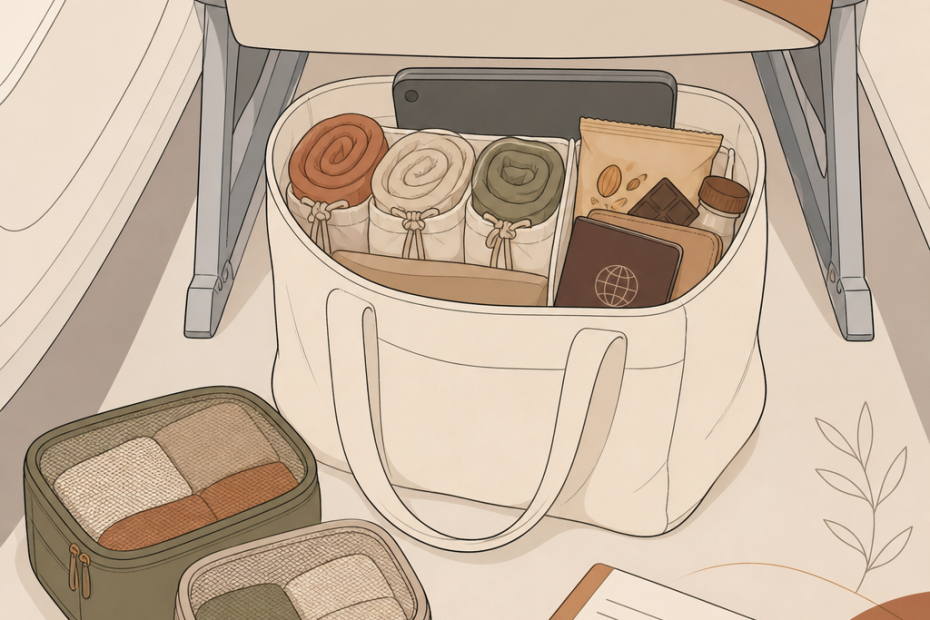
Packing a tote as your personal item is the oldest travel trick in the book — and the most often botched. Done right, a single tote carries everything you need during the flight plus a backup change of clothes, while keeping valuables within reach. Done wrong, it turns into a black hole where your boarding pass sinks to the bottom and the bag refuses to fit under the seat. This guide covers the packing system that works, what belongs in a personal-item tote, and how to keep it under the airline’s size limits.
How to Pack a Tote Bag as a Personal Item: The Complete System
Sponsored: This article contains product links. We may earn a commission on qualifying purchases at no extra cost to you.
Why a Tote Is a Great Personal Item
A tote is one of the best personal item choices because it combines easy access with generous capacity. Unlike a backpack, which requires unstrapping and rummaging, a tote opens fully at the top — you can reach your passport, phone, or snacks without removing the bag from your shoulder. It also fits under the seat in front of you on nearly all airlines when kept to the standard 18 x 14 x 8 inch (46 x 36 x 20 cm) limit.
The trade-off: totes are open bags, so organization matters. Without interior pockets or packing pouches, everything migrates to the bottom. The solution is a simple three-layer packing system.
Summary: A tote makes an ideal personal item because it offers top-down access and under-seat fit. Success depends on organizing the interior with a layered packing system rather than tossing items in loose.
The Three-Layer Personal Item System
| Layer | What goes here | Purpose |
|---|---|---|
| 1. Base | Rolled clothes, flat pouches | Stable foundation |
| 2. Middle | Electronics, heavier items | Protection and balance |
| 3. Top | Passport, phone, snacks | Quick access |
The Three-Layer Packing System
Layer 1 — the base: flat, rarely-needed items go at the bottom. A rolled change of clothes, a folded pashmina or light sweater, and a flat pouch of emergency toiletries. These create a stable foundation that also protects the items above.
Layer 2 — the middle: electronics and heavier items lie flat against the back panel: tablet, e-reader, chargers, and a small pouch with cables. Keeping them flat prevents screen pressure and makes the bag balance better when carried.
Layer 3 — the top: in-flight essentials go on top for instant access: snacks, headphones, book, phone, lip balm.
Exterior or top pockets: passport, boarding pass, and hand sanitizer — the items you reach for at security and boarding.
What to Pack in a Personal-Item Tote
The ideal personal-item tote carries flight necessities plus a contingency layer:
- Passport, boarding pass, and wallet
- Phone, charger, and earbuds
- Snacks and an empty water bottle (fill after security)
- Medications and a small toiletry pouch
- A change of clothes or sleepwear rolled in a pouch
- Light layer: sweater, pashmina, or packable jacket
- Book, e-reader, or tablet
- Travel pillow or eye mask (optional)
The key principle: if your carry-on gets gate-checked, your personal item must still contain everything you need for the flight and one night. Pack accordingly.
Packing Cubes: Worth It or Not?
Packing cubes are worth it in a tote, but not the way most people use them. Large cubes waste space in a small tote. The effective approach is using small, slim pouches — one for cables, one for toiletries, one for a change of clothes — rather than a single big cube. This creates zones inside the tote without eating the limited volume.
The one exception: a small compression cube for the change of clothes. It shrinks the bulge that makes totes fail the under-seat test.
Staying Within Airline Limits
Most US airlines allow a personal item up to 18 x 14 x 8 inches (46 x 36 x 20 cm); United’s limit is 17 x 10 x 9 inches (43 x 25 x 23 cm). European budget carriers like Ryanair enforce smaller limits. Three habits keep your tote compliant:
Pack to 80% full. An overstuffed tote bulges past nominal dimensions and fails sizers. Leave slack so the bag compresses.
Weigh the bag. European carriers weigh personal items (often 7-10 kg / 15-22 lb). Weigh at home before flying.
Choose soft-sided. A soft canvas tote squishes into a sizer; a rigid structure does not. The extra-large canvas tote (see the large canvas tote) is soft-sided yet structured enough to carry a laptop safely.
Related Topics You May Find Helpful
Can a Tote Bag Be a Personal Item on a Flight?
Yes. A tote up to the airline’s personal item limit (typically 18 x 14 x 8 inches / 46 x 36 x 20 cm) fits under the seat and is accepted as a personal item on all major airlines.
What Is the 5-4-3 Rule for Packing?
A common packing guideline for week-long trips: 5 tops, 4 bottoms, and 3 pairs of shoes. It is a starting point for minimal packing, not a hard rule — adjust based on your itinerary and season.
What Is the Most Forgotten Item When Traveling?
Chargers and cables are consistently the most forgotten travel items. Keep a dedicated cable pouch permanently packed in your personal item to eliminate this problem.
Frequently Asked Questions About Personal-Item Totes
Can my backpack be a carry-on and my tote be a personal item?
Yes, if the airline allows one carry-on plus one personal item. The backpack goes overhead; the tote goes under the seat. Just confirm the tote fits the personal item size limit.
What should I put in my personal item vs. my carry-on?
Put flight essentials and valuables in the personal item: passport, phone, medications, a change of clothes. Put bulk in the carry-on: extra clothing, shoes, and non-essentials.
Do personal items have weight limits?
US airlines rarely weigh personal items. European carriers often do — typically 7 to 10 kg (15 to 22 lb). Keep the packed tote within your airline’s limit.
Key Takeaways
- A tote is a great personal item: top-down access, under-seat fit, and generous capacity.
- Use a three-layer system — base (rarely needed), middle (electronics), top (in-flight essentials).
- Keep the tote packed to 80% so it compresses into airline sizers.
- Small pouches organize a tote better than one large packing cube.
- Your personal item should cover the flight plus one night if the carry-on gets gate-checked.