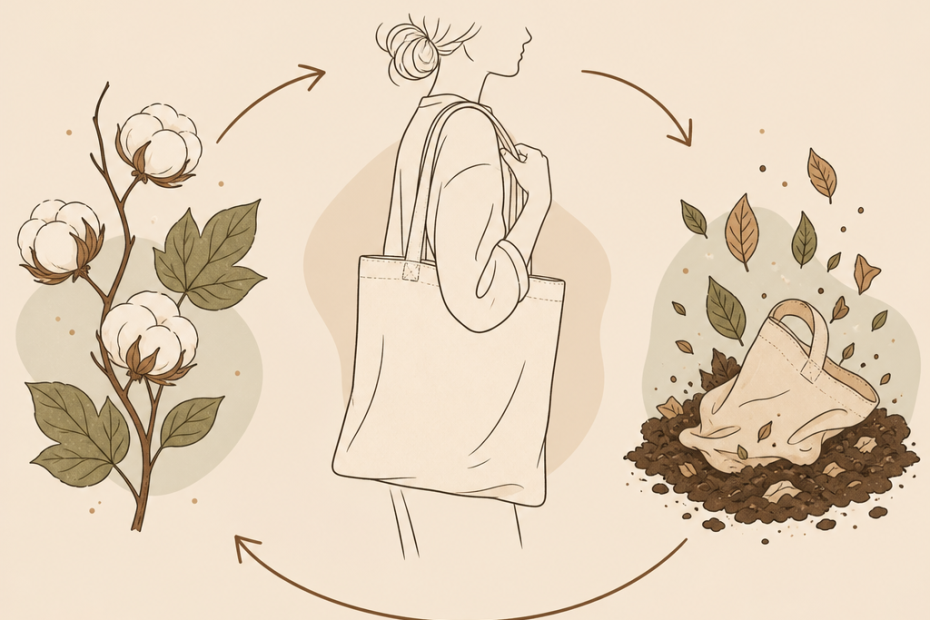
Buying a sustainable tote bag made from organic cotton is easy; using one sustainably is the harder part. The bag’s environmental impact is determined less by its label than by how many times you carry it, how you wash it, and what happens at the end of its life. A GOTS-certified organic cotton tote used twice a week for three years outperforms a “premium” sustainable bag that sits unused in a closet. This guide looks at the full lifecycle of an organic cotton tote — production, use, care, and disposal — and shows how to get the most environmental value from your purchase.
Lifecycle of a Sustainable Organic Cotton Tote: From Farm to Compost
Sponsored: This article contains product links. We may earn a commission on qualifying purchases at no extra cost to you.
The Lifecycle Has Four Stages — Most Buyers Only Think About One
A tote bag’s environmental footprint is spread across four stages: raw material production, manufacturing, use, and end-of-life. Most shoppers focus only on the first stage (organic vs. conventional cotton) and ignore the other three — but the use stage often matters most. A bag carried 200 times has its production footprint diluted across those uses; a bag carried 10 times does not. This is why durability and frequency of use are sustainability features, not just convenience features.
Summary: A tote’s environmental impact spans production, manufacturing, use, and disposal. The use stage — how often and how long you carry the bag — determines most of its lifetime footprint.
Organic Cotton Totes Worth Carrying
A 100% organic cotton tote with reinforced handles handles weekly grocery loads — the durability-first choice for the use stage that matters most see the organic cotton tote on Amazon.
A roomy organic cotton grocery tote with a wide base carries heavy loads without tearing see the roomy grocery tote on Amazon.
A heavyweight natural canvas tote ages well through hundreds of washes — the practical choice for daily use see the heavyweight canvas tote on Amazon.
Stage 1: Organic Cotton Production
Organic cotton is grown without synthetic pesticides, synthetic fertilizers, or genetically modified seeds. The Textile Exchange’s organic cotton market data shows organic production uses roughly 91% less water than conventional cotton under comparable growing conditions [1]. GOTS (Global Organic Textile Standard) certification verifies not just the farming but the entire supply chain, including processing chemicals and social criteria.
The practical takeaway: choose GOTS-certified organic cotton, and treat certification as the minimum bar — it is the difference between a verified claim and marketing language.
Stage 2: Manufacturing and Construction
Manufacturing matters in two ways: the energy and water used in weaving and finishing, and the bag’s build quality, which determines lifespan. A durable bag built from 14 oz (470 gsm) canvas with reinforced handles will be used hundreds of times; a flimsy bag tears after twenty. When comparing sustainable totes, prioritize construction quality as a sustainability feature.
Fair Trade certification adds the social dimension — fair wages and safe conditions for the people who make the bag. A tote can be GOTS-certified (environmental) and Fair Trade-certified (social) simultaneously.
Stage 3: Use — Where You Control the Impact
This is the stage you control. Three habits maximize the environmental value of your tote:
Carry it often. Lifecycle assessments generally estimate a cotton tote needs 50-100 uses to offset its production footprint versus single-use plastic bags. Weekly grocery trips plus gym and errand use reach that threshold within a year.
Wash it right. Cold water, gentle cycle, hang dry. Hot water and machine drying consume energy and shrink the fabric. Washing less frequently (spot-clean when possible) also reduces impact.
Keep it out of the landfill. A tote retired after a year wasted its production footprint. Repair small tears, repurpose it, or pass it on.
Impact levers you control:
| Habit | Effect | Difficulty |
|---|---|---|
| Carry 2+ times per week | Reaches break-even footprint in ~1 year | Easy |
| Cold wash + hang dry | Reduces energy use, prevents shrinkage | Easy |
| Spot-clean between washes | Fewer washes, longer fabric life | Easy |
| Repair instead of replace | Extends bag life by years | Moderate |
Stage 4: End of Life
One of organic cotton’s strongest advantages is its end of life. A 100% cotton canvas tote — without synthetic zippers, linings, or coatings — is biodegradable and compostable. Remove the zipper and hardware, cut the bag into pieces to speed decomposition, and compost it. This contrasts sharply with polyester and nylon bags, which persist in landfills for centuries.
Not all “organic cotton” totes are fully compostable: check for synthetic linings, coated finishes, and metal hardware that must be removed first.
Related Topics You May Find Helpful
How Many Times Must You Use a Tote to Offset Its Impact?
Lifecycle assessments generally place the break-even point at 50 to 100 uses versus single-use plastic bags. A tote used weekly for groceries and errands reaches that threshold within a year.
Is Organic Cotton Tote Better Than Recycled Polyester?
For end-of-life, yes — organic cotton is biodegradable while polyester sheds microplastics and persists in landfills. For production, recycled polyester diverts plastic waste but uses more energy in recycling. Each has strengths; cotton wins on disposal.
Can a Tote Be Both GOTS and Fair Trade Certified?
Yes. GOTS covers environmental and processing criteria; Fair Trade covers labor and social criteria. Together they address the full sustainability picture.
Frequently Asked Questions About Sustainable Totes
What makes a tote bag sustainable?
A sustainable tote combines verified organic or recycled materials, durable construction that enables years of use, and biodegradable end-of-life. All three factors matter — material alone is not enough.
How do I dispose of an old cotton tote?
Compost it if it is 100% cotton without synthetic components. Otherwise, donate it, repurpose it as a storage bag, or recycle it through a textile program.
Do organic cotton totes cost more?
Slightly — organic farming and certification add cost. But the premium is small relative to a multi-year lifespan, and the cost per use of a durable organic tote beats cheap bags you replace.
Key Takeaways
- A tote’s impact spans production, manufacturing, use, and disposal — the use stage matters most.
- GOTS certification verifies organic cotton through the full supply chain.
- Carry the tote 50-100 times to offset its footprint — frequency is a sustainability feature.
- Cold wash and hang dry to extend fabric life and reduce energy use.
- 100% cotton totes are biodegradable — remove hardware and compost at end of life.