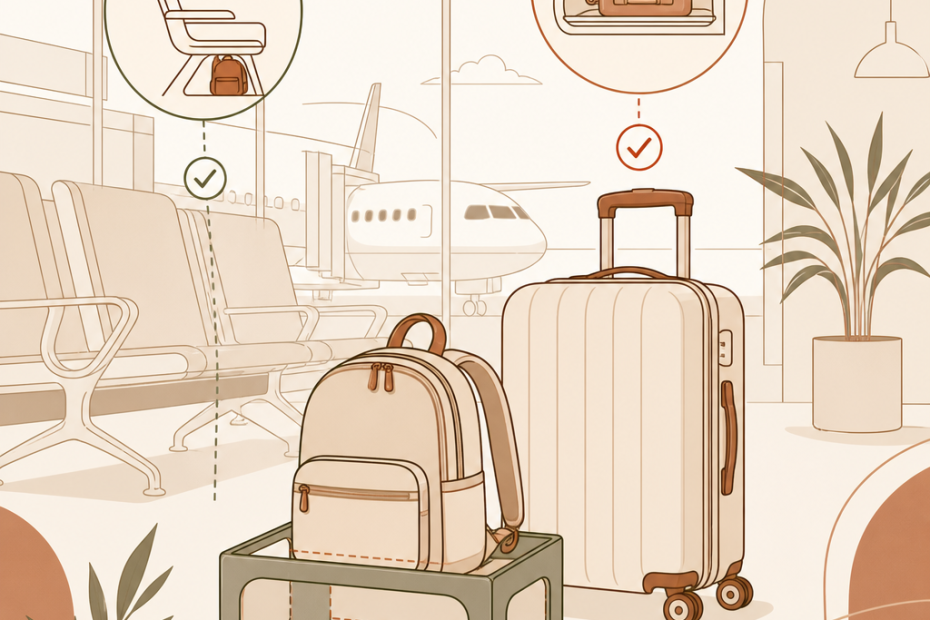
Most travelers know they get a carry-on and a personal item, but few know the difference matters more than they think. A personal item — a backpack, tote, or laptop bag that fits under the seat — is free on almost every airline, while carry-on bags may cost extra on budget carriers. Choosing the right bag for each role, and packing them in the right order, can save money, time, and stress at the gate. This guide breaks down the size rules, the packing strategy, and the common mistakes travelers make.
Carry-On vs. Personal Item Bag: Packing Guide That Saves You Money
Sponsored: This article contains product links. We may earn a commission on qualifying purchases at no extra cost to you.
The Difference That Costs or Saves You Money
A carry-on bag goes in the overhead bin and typically measures up to 22 x 14 x 9 inches (56 x 36 x 23 cm). A personal item fits under the seat in front of you and typically measures up to 18 x 14 x 8 inches (46 x 36 x 20 cm). On most full-service airlines, both are included in your fare. On budget carriers — Frontier, Spirit, Ryanair, easyJet — a personal item is free but a carry-on costs extra, often $30 to $80 per flight segment.
The financial takeaway: if you can fit everything in a personal-item-sized bag, you eliminate the carry-on fee entirely. A backpack sized to 18 x 14 x 8 inches (see the 18x14x8 backpack) unlocks fee-free travel on budget carriers.
Summary: A carry-on goes overhead and measures up to 22 x 14 x 9 inches; a personal item fits under the seat and measures up to 18 x 14 x 8 inches. Personal items are free on budget airlines; carry-ons often cost extra.
What Counts as a Personal Item
Airlines accept any bag that fits under the seat as a personal item: backpacks, totes, laptop bags, duffels, camera bags, and even small weekender bags within the size limit. The key requirement is that it fits in the sizer at the gate without forcing.
What does not count: items that must be carried separately, like garment bags, strollers, and medical equipment — though policies vary. Pets in carriers count as a personal item on some airlines and as a separate allowance on others. Check before flying.
Typical size limits:
| Bag type | Typical limit | Where it goes | Usually free? |
|---|---|---|---|
| Personal item | 18 x 14 x 8 in (46 x 36 x 20 cm) | Under the seat | Yes, all airlines |
| Carry-on | 22 x 14 x 9 in (56 x 36 x 23 cm) | Overhead bin | Full-service yes; budget often no |
| Checked bag | 62 linear in (158 cm) | Cargo hold | Usually fees apply |
How to Pack a Personal Item for Maximum Space
A personal-item bag has limited space, so every item must earn its place:
Layer 1 (bottom): rolled clothing in packing cubes. Rolling compresses clothes and prevents wrinkles better than folding.
Layer 2 (middle): electronics and chargers, flat against the back panel where they stay protected.
Layer 3 (top): items you need during the flight — snacks, headphones, book, phone.
Exterior pockets: passport, boarding pass, hand sanitizer.
The ECOHUB airline-approved personal item backpack (see the ECOHUB personal item bag) is sized to budget-carrier limits with dedicated compartments that keep this packing system organized.
How to Pack a Carry-On (When You Need One)
When you need a carry-on instead of just a personal item — longer trips, colder destinations, or family travel — the packing strategy changes:
- Use packing cubes by category (shirts, pants, undergarments) for fast access.
- Wear your heaviest items on the plane: boots, jacket, and a large sweater.
- Keep a change of clothes and toiletries in the personal item in case the carry-on is gate-checked.
- Leave 10-15% of the carry-on empty for souvenirs.
- Weigh the bag at home — budget airlines enforce 7-10 kg (15-22 lb) carry-on limits.
The One-Bag Strategy: Personal Item Only
For short trips (2-4 days), a personal-item-only strategy eliminates all baggage fees and gate checks. A 30L backpack fits 3-4 days of clothing, toiletries, and electronics when packed with cubes. The HILOMON 30L travel backpack (browse the 30L personal item backpack) is an affordable entry into this approach.
The trade-off: you cannot bring large liquid containers, multiple pairs of shoes, or bulky jackets. But for city breaks and business trips, the freedom of walking off the plane with one small bag outweighs the packing constraints.
Related Topics You May Find Helpful
Can a Backpack Be a Personal Item?
Yes. Any backpack that fits under the seat in front of you — typically up to 18 x 14 x 8 inches (46 x 36 x 20 cm) — counts as a personal item. It must fit in the airline’s sizer without being forced.
Is a Tote Bag a Personal Item?
Yes, if it fits under the seat. Totes are a popular personal item choice because they are easy to access and fit the size limits of most airlines.
What Happens If My Personal Item Is Too Big?
The airline will either charge you a carry-on fee or force you to gate-check the bag. Both cost money and time. Measure your bag against the airline’s listed limits before arriving at the airport.
Frequently Asked Questions About Carry-Ons and Personal Items
What is the difference between a carry-on and a personal item?
A carry-on fits in the overhead bin (up to 22 x 14 x 9 inches / 56 x 36 x 23 cm) and may cost extra on budget airlines. A personal item fits under the seat (up to 18 x 14 x 8 inches / 46 x 36 x 20 cm) and is free on all airlines.
Do I get both a carry-on and a personal item?
On full-service airlines, yes — most include both in the fare. On budget carriers, the personal item is included but the carry-on costs extra. Check your airline’s specific policy.
What should I put in my personal item vs. my carry-on?
Put everything you need during the flight and valuables in the personal item: passport, phone, electronics, medications, a change of clothes. Put bulkier items in the carry-on: extra clothing, shoes, and non-essential gear.
Key Takeaways
- Personal items (18 x 14 x 8 in / 46 x 36 x 20 cm) are free on all airlines; carry-ons often cost extra on budget carriers.
- An 18 x 14 x 8 inch backpack unlocks fee-free travel on budget airlines.
- Pack the personal item with flight essentials and valuables; the carry-on holds bulk.
- Use packing cubes and roll clothing to maximize space in both bags.
- For 2-4 day trips, a personal-item-only strategy eliminates all baggage fees.