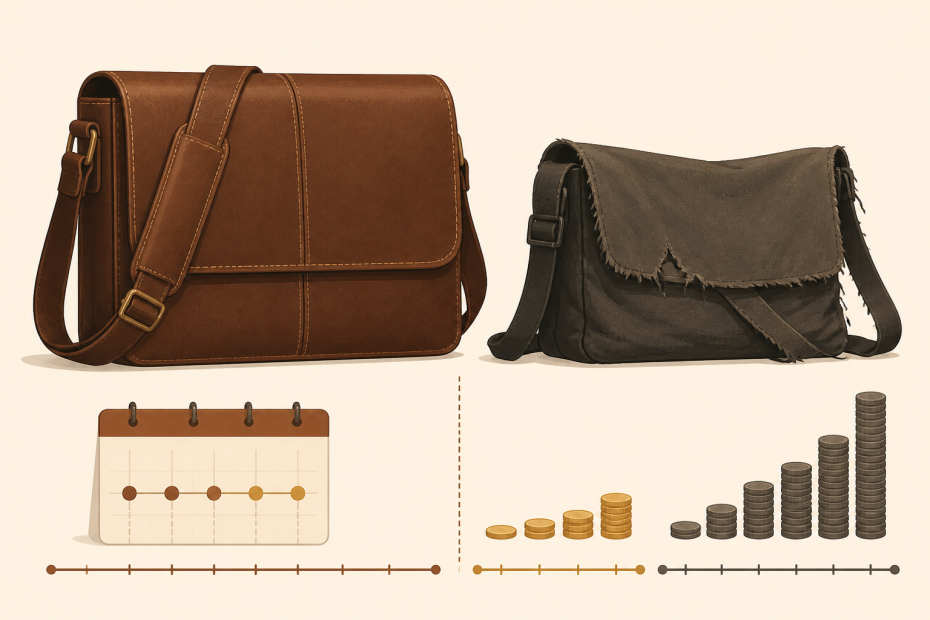
A messenger bag around $20 and one around $150 look similar on a product page. The difference shows up eighteen months later, when the cheap one’s strap stitches pull loose and the seams start fraying — and the “savings” vanish into a replacement purchase. This guide breaks down the real cost of bags over time, what quality construction actually costs, and how to tell durable craftsmanship from a good photo.
Why Quality Matters: The True Cost of Cheap Bags
The sustainability case for quality is simple arithmetic: a bag that lasts five years replaces several cheap bags that fail in a year or two, and the EPA’s reuse logic applies directly — each durable reusable bag replaces hundreds of single-use alternatives over its life (EPA, Ten Ways to Unpackage Your Life). When a bag is a daily carry item, the cheapest option is rarely the most economical — and almost never the most sustainable.
Cost Per Year: The Number That Matters
Compare bags by cost per year of use, not sticker price. A bag around $20 that fails in 12 months costs about $20 per year. A bag around $150 that lasts 7–10 years costs about $15–21 per year — and if it lasts a decade, it undercuts the cheap bag on cost while producing far less waste. This is the honest math behind “buy it once, buy it right,” and it is why durability is the single most important feature in a sustainable carry purchase.
The caveat: a high price tag is not a guarantee of quality. The real signals are construction details — stitching, hardware, material weight — not the brand or the price alone.
The Short Answer
Judge bags by cost per year of use, not sticker price: a bag around $20 that fails in a year costs about $20/year, while a bag around $150 that lasts a decade costs about $15/year and produces far less waste. Durability is the key sustainability feature — but price alone does not guarantee quality; construction details do.
What Quality Construction Actually Looks Like
Four details separate durable bags from disposable ones. Stitching: look for double-stitched seams and bar-tacked stress points, especially at strap attachments, which are the most common failure location. Hardware: quality buckles, zippers, and clips from reputable suppliers survive daily use; cheap hardware is the second-most-common failure point. Material: heavy canvas (12 oz / 405 g/m² or heavier), full-grain leather, and coated technical fabrics outlast lighter alternatives. And design: a structured base, reinforced handles, and thoughtful load distribution prevent the wear that kills bags early.
The honest way to verify quality is reviews — specifically owner reports of bags lasting years versus complaints about stitching or zippers failing quickly. Patterns in reviews are more reliable than marketing claims.
Key Facts at a Glance
Quality construction means double-stitched seams with bar-tacked stress points, quality hardware (zippers, clips, buckles), heavy materials (12 oz / 405 g/m²+ canvas, full-grain leather, coated fabrics), and thoughtful design like reinforced handles. Strap attachments fail first, then hardware. Owner reviews reveal real durability; marketing does not.
The Categories Worth Investing In
Not every bag needs premium construction — match investment to frequency of use. Daily-carry items (work messengers, commuting backpacks, laptop bags) earn their quality premium because they face daily stress and are replaced most often when cheap. Occasional-use items (event totes, beach bags, storage bags) can be more economical. The highest-value upgrades are the bags you carry every day in demanding conditions.
For professional carry specifically, a quality messenger or laptop bag is an investment in both durability and appearance — a well-made leather or heavy-canvas bag develops character with age, while cheap bags look worn out rather than broken in.
Where Quality Pays Off
Invest in daily-carry items — work messengers, commuting backpacks, laptop bags — where quality prevents frequent replacement. Occasional-use bags can be budget-friendly. A quality professional bag lasts years, looks better with age, and undercuts cheap replacements on cost per year.
Comparing Price Points Honestly
| Category | Typical price | Expected life | Cost per year |
|---|---|---|---|
| Budget messenger / laptop bag | about $15–30 | 1–2 years | about $8–30/yr |
| Mid-range canvas messenger | about $45–75 | 3–5 years | about $9–25/yr |
| Premium leather / waxed canvas | about $100–200+ | 7–10+ years | about $10–29/yr |
| Technical waterproof pack | about $70–150 | 5–8 years | about $9–30/yr |
The pattern is clear: well-made bags cluster in the same cost-per-year range as cheap ones while producing a fraction of the waste. The differentiator is not price — it is whether the bag actually lasts, which construction quality and materials determine.
Bag quality: the true cost of the cheap
Bag quality discussions have a math at the center: the cheap bags cost more per year. The conversations are consistent — the bag quality — the cost per year, the durability, and the value — favors the quality, and the short-answer angle covers the reasoning.
The practical advice: understand the cost-per-year number — the cheap bag replaced yearly versus the quality bag carried for the years — and the durability: the materials, the stitching, and the repairs. The bag that works is the one that lasts and serves. The true cost that matters is the one the quality math revealed.
Price Comparison Takeaway
Across budget, mid-range, and premium bags, cost per year is surprisingly similar — roughly $8–30/year — but premium bags last 5–10+ years versus 1–2 for budget options, producing far less waste. The deciding factor is construction quality, not sticker price.
Related Topics You May Find Helpful
Is it worth buying an expensive messenger bag? For daily professional carry, yes — a well-made bag that lasts a decade costs the same per year as a cheap bag that fails annually, with far less waste.
How can I tell if a bag is well made? Check stitching (double-stitched, bar-tacked stress points), hardware quality, material weight, and owner reviews for durability reports over time.
What is the most durable bag material? Full-grain leather, heavy waxed canvas (12 oz / 405 g/m²+), and coated technical fabrics are the leaders; construction quality matters as much as material.
Do expensive bags hold their value? Some premium brands retain resale value, but the primary value of quality is years of use — resale is a bonus, not the reason to buy well.
What we covered
- Compare bags by cost per year of use — quality bags match or beat cheap ones on cost.
- A bag around $150 lasting a decade costs about $15/year; a bag around $20 failing yearly costs about $20/year.
- Quality signals: double stitching, bar-tacked stress points, quality hardware, heavy materials.
- Strap attachments and hardware fail first — inspect them before buying.
- Invest in daily-carry items; budget is fine for occasional-use bags.
- Owner reviews reveal real durability; marketing claims do not.
Featured Quality Bags
These verified products illustrate the quality spectrum — from budget-friendly messengers to premium leather and waxed canvas carry. All links open in a new tab.
| Product | Position | Price |
|---|---|---|
| Amazon Basics 15.6″ Laptop Messenger Bag | Budget entry point | About $16 |
| Canvas Messenger Bag, satchel for 14″ laptop | Mid-range canvas | About $30 |
| Oak Leathers Leather Messenger Bag (laptop briefcase) | Genuine leather, professional | About $63 |
| Vintage Genuine Leather Waxed Canvas Briefcase (15.6″ laptop) | Waxed canvas + leather | About $49 |
| Timbuk2 Classic Messenger Bag (13″/15″/17″ laptop) | Premium commuter icon | About $149 |
- See the budget entry point and set expectations accordingly
- Compare a mid-range canvas messenger for daily use
- Explore a genuine leather professional messenger
- Check a waxed canvas and leather briefcase for long-term carry
- See the Timbuk2 Classic — the premium commuter benchmark
Disclosure: This article contains sponsored content and product links. If you make a purchase through the links in this post, we may earn a commission at no extra cost to you. Product evaluations are based on published specifications and general product-class knowledge; we have not personally tested every item featured.
FAQ
How long should a quality messenger bag last? A well-made leather or heavy-canvas messenger should last 7–10+ years with basic care; budget bags typically fail in 1–2 years.
What fails first on a cheap bag? Strap-attachment stitching is the most common failure point, followed by zippers and hardware — inspect these before buying.
Is a more expensive bag always better? No — price is not a quality guarantee. Evaluate stitching, hardware, materials, and owner reviews regardless of price.
How do I extend a bag’s life? Basic care: condition leather, re-wax canvas, avoid overloading, and repair small issues early — maintenance is cheaper than replacement.